
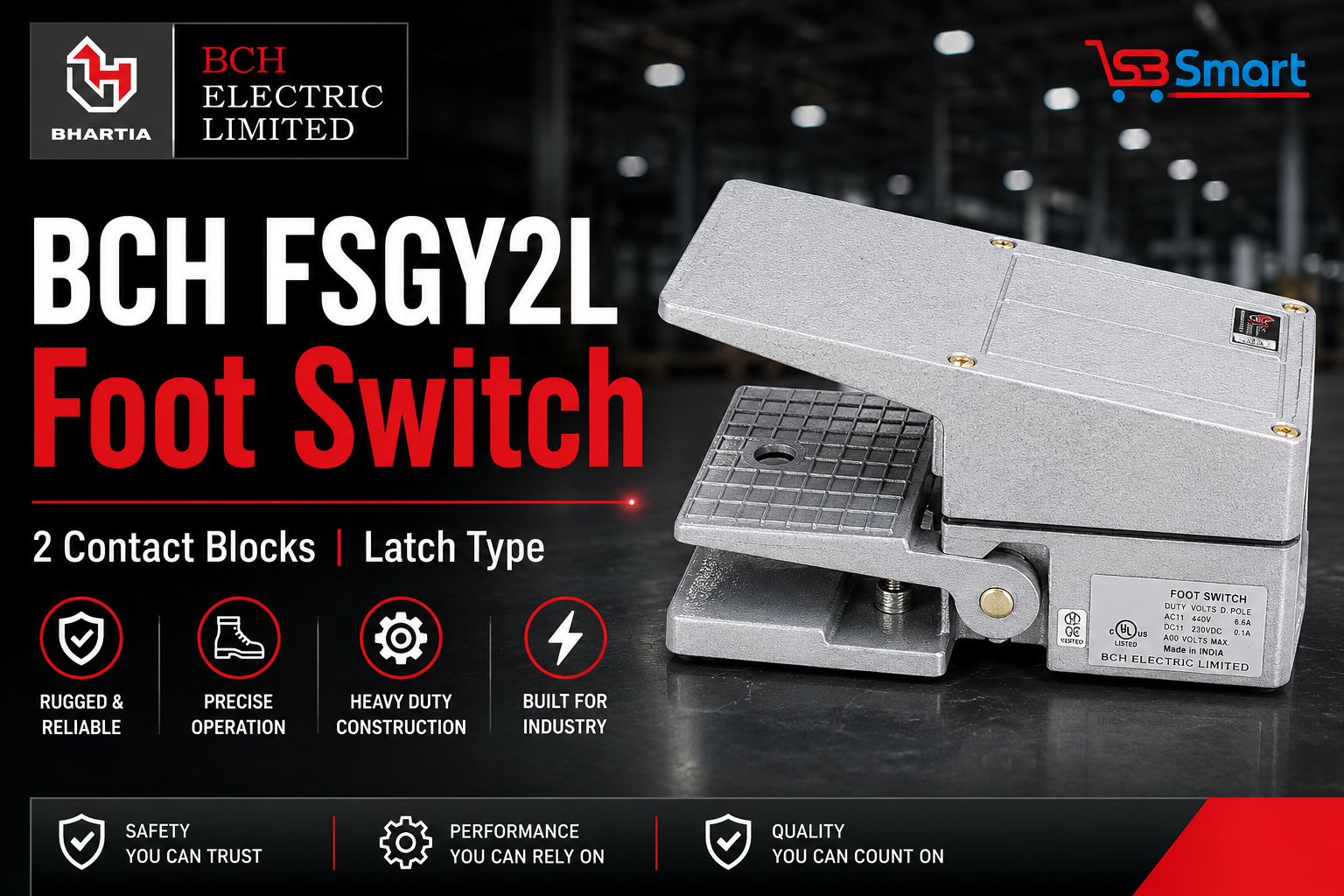
Hands Full? Let Your Foot Do the Switching: A Straight-Talking Guide to the BCH FSGY2L Foot Switch
Walk onto the floor of any welding bay, rubber press, or machine tool shop and you'll spot operators doing something that looks almost automatic - tapping a pedal on the ground without even glancing down. That pedal is a foot switch, and when both hands are busy holding a workpiece, guiding a weld, or feeding material, it is often the only practical way to control a machine safely. The BCH FSGY2L is one of the more capable options in this category, built specifically for situations where a single contact circuit simply isn't enough.
What the FSGY2L Actually Is
The FSGY2L belongs to BCH Electric's FSG series of foot switches, a product line built for heavy-duty industrial use rather than light-duty or occasional operation. The "L" in the name signals the latch variant - meaning the pedal can be locked down in the pressed position when a machine needs to run continuously, rather than requiring constant foot pressure to stay engaged. What sets the FSGY2L apart within its own range is the number of contact blocks it carries: two. Each additional contact block adds another switching circuit to the same pedal action, which matters a great deal once you look at how these switches actually get wired into real machines.
Why Two Contact Blocks Actually Matters
A basic single-block foot switch typically gives you one switching circuit - fine for a simple on/off pilot signal. Step up to a switch built around two contact blocks, and you are generally looking at a combined 4NO+4NC arrangement, meaning four normally-open and four normally-closed contacts operating together from the same single pedal press. In practical terms, this means one foot movement can simultaneously control multiple independent circuits - for example, energizing a machine's start circuit while also feeding a signal to a separate interlock, indicator, or PLC input, all from a single, simple mechanical action. For machine builders who need more than a basic start/stop function but still want the reliability of a purely mechanical pedal, this extra contact capacity removes the need for additional relays or auxiliary switching hardware bolted on separately.
Built for Genuinely Rough Duty
The contact mechanism inside BCH's FSG series switches sits enclosed in a moulded phenolic block - a tough, heat-resistant material choice that holds up well in environments where dust, vibration, and repeated mechanical stress are just part of daily operation. These switches are designed to open and close both AC and DC pilot circuits, giving them flexibility across different control system designs rather than being locked into one voltage type. This construction is exactly why you'll find BCH foot switches showing up again and again in some of the more punishing corners of a factory floor rather than in delicate or clean-room settings.
Where the FSGY2L Actually Gets Used
Machine Tools - Lathes, presses, and drilling equipment where an operator's hands need to stay on the workpiece or fixture while controlling the machine's cycle.
Rubber and Tyre Manufacturing - Processes involving molding, curing, or shaping equipment where consistent, hands-free activation keeps production moving safely.
Special Purpose Machines (SPMs) - Custom-built production equipment where a foot switch is often integrated directly into the machine's control panel design from day one.
Welding Equipment - Where both hands are almost always occupied holding the workpiece or the welding torch, making a foot-operated control the only realistic option for triggering the weld cycle.
Latch vs Guard: Picking the Right Variant
BCH's FSG range typically comes in a few configurations, and it's worth knowing the difference before ordering. The "Guard" variants add a protective cover over the pedal to prevent accidental activation - useful in busy areas where something could fall onto the switch or a foot could brush against it unintentionally. The "Latch" variants, like the FSGY2L, instead let the operator lock the pedal down for continuous operation, which suits processes that need to stay engaged for extended periods rather than momentary pulses. Choosing between them comes down to how the switch will actually be used - momentary, protected activation versus a hold-down function for continuous-run processes.
Standards and Reliability
BCH's foot switch range is built to conform to IEC-60947 series standards, the international benchmark for low-voltage switchgear and control gear. For panel builders and OEMs working on equipment that needs to meet recognized safety and performance benchmarks, sourcing a switch that already aligns with this standard removes one more variable from the compliance checklist.
A Few Things Worth Checking Before You Order
- Confirm whether your control circuit actually needs all four NO and four NC contacts, or whether a single contact block variant would suffice - this affects both cost and panel wiring complexity.
- Decide between the latch and guard variant based on how the machine cycle actually runs - continuous engagement versus momentary, protected activation.
- Check the rated voltage and current of your control circuit against the switch's contact rating before finalizing the panel design.
- If replacing an existing foot switch, confirm mounting footprint and cable entry position match your current panel layout to avoid rework.
Frequently Asked Questions
What does FSGY2L mean in BCH's foot switch naming?
FSG identifies the foot switch series, Y2 refers to the two-contact-block configuration, and L indicates the latch variant that allows the pedal to be locked in the pressed position for continuous operation.
How many contacts does the FSGY2L actually have?
With two contact blocks fitted, the FSGY2L typically provides a combined 4NO+4NC contact arrangement, giving four normally-open and four normally-closed contacts from a single pedal action.
Can the FSGY2L handle both AC and DC circuits?
Yes. BCH's FSG series foot switches are designed to open and close both AC and DC pilot circuits, making them suitable for a range of control system designs.
What is the difference between the Guard and Latch versions?
The Guard version adds a protective cover to prevent accidental activation, while the Latch version lets the operator lock the pedal down for continuous, hands-free operation during extended machine cycles.
What industries commonly use this foot switch?
Machine tool operation, rubber and tyre manufacturing, special purpose machines (SPMs), and welding equipment are among the most common applications, largely because these processes require both hands free while still needing precise machine control.
Is the FSGY2L suitable for heavy-duty industrial use?
Yes. The contact mechanism is enclosed in a moulded phenolic block designed for demanding factory-floor conditions, and the switch conforms to IEC-60947 standards for low-voltage switchgear and control gear.
Sourcing a Genuine BCH FSGY2L
Foot switches sit directly in the operator's control path, which makes reliability non-negotiable rather than a nice-to-have. A switch that fails to actuate cleanly, or one built with substandard contact materials, doesn't just cause downtime - it can compromise how safely a machine cycle actually runs. You can check current availability and specifications for the BCH FSGY2L Foot Switch at SB Smart. If you have the exact product page link for this model, share it and it can be linked directly so readers land straight on the correct listing.
The Bottom Line
The BCH FSGY2L isn't a flashy piece of equipment, and it was never meant to be. It's the quiet, reliable pedal underfoot that lets an operator keep both hands exactly where they need to be - on the workpiece, the torch, or the material - while still maintaining full, precise control over the machine. With two contact blocks, a latch mechanism for continuous-duty applications, and construction built for genuinely rough environments, it's a small component doing a job that a lot of heavy-duty machinery genuinely cannot run safely without.