
In industrial automation, timing is everything. A motor should not always start the moment a circuit is activated, and some machines need a controlled delay before the next operation begins. These small timing requirements can make a significant difference to the safety, coordination, and efficiency of an industrial process.
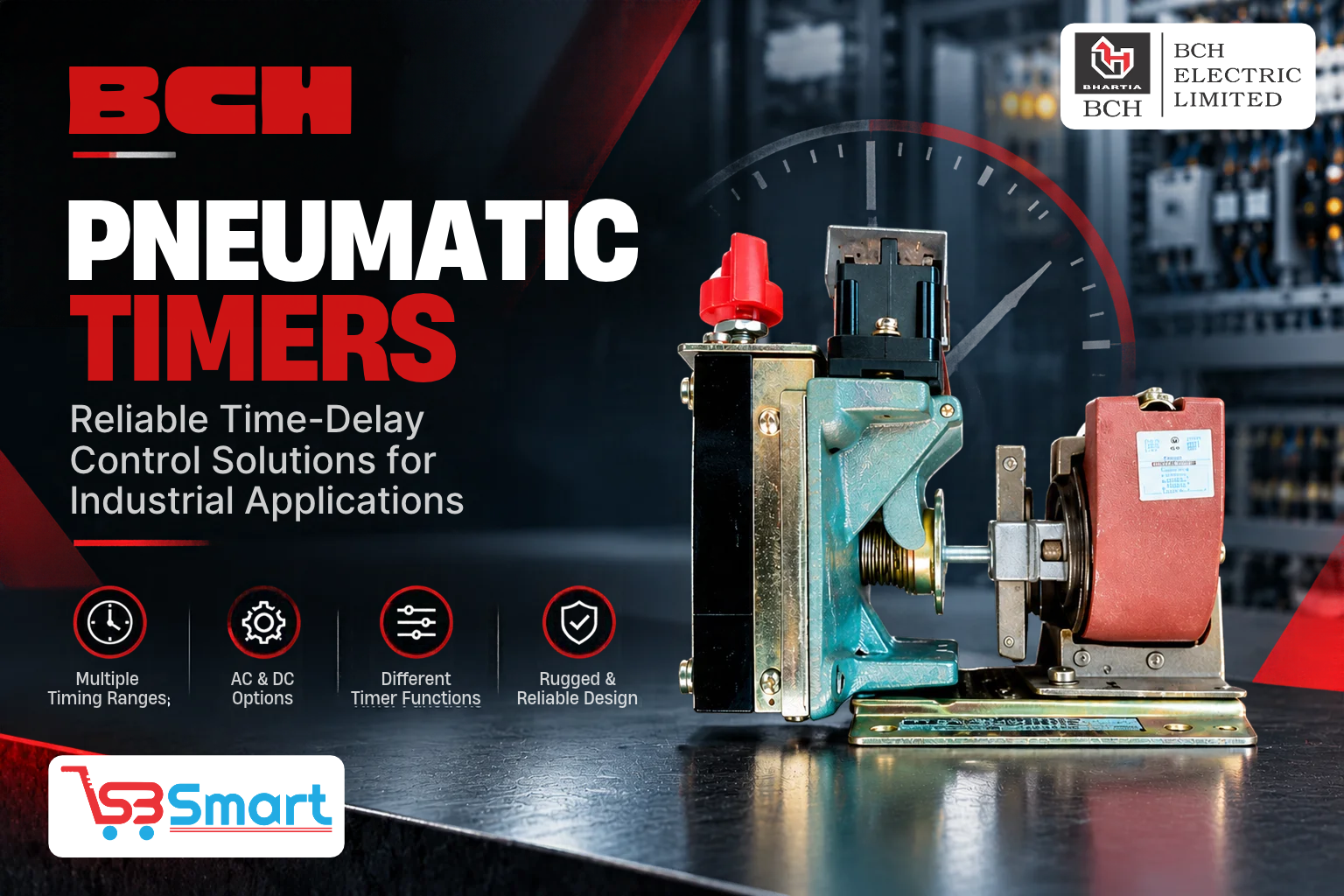
This is where BCH Pneumatic Timers come into the picture. Designed for time-delay control applications, these electro-pneumatic timers help manage the sequence of electrical operations in industrial systems. For businesses looking for dependable industrial control components, SB Smart offers access to BCH pneumatic timer products for a variety of control and automation requirements.
Whether you are maintaining an existing control panel, upgrading industrial equipment, or building a new automation system, choosing the right timer can help your equipment operate in a more organised and predictable manner.
What Are BCH Pneumatic Timers?
A pneumatic timer is a timing device that introduces a preset delay into a control circuit. In industrial applications, this delay allows one operation to take place before another action is triggered.
BCH pneumatic timers are electro-pneumatic time-delay relays used in industrial control systems. They are designed to provide timed switching and help coordinate operations where an immediate response is not desirable.
For example, a machine may require a short delay between energising a control circuit and activating another component. Instead of relying on manual intervention, a suitable time-delay relay can help automate that sequence.
The result is better control over machine operations and a more consistent approach to industrial process management.
Key Features of BCH Pneumatic Timers
When selecting a timer for an industrial application, it is important to look beyond the timing function alone. The operating environment, contact arrangement, supply voltage, and maintenance requirements also matter.
BCH pneumatic timers offer several useful features.
1. Multiple Timing Ranges
BCH provides pneumatic timer options with timing ranges of 30 seconds, 60 seconds, and 180 seconds, depending on the model.
This range gives engineers and panel builders flexibility when selecting a timer for applications that require different time delays. The appropriate range should be chosen according to the actual sequence and operating requirements of the equipment.
2. AC and DC Supply Options
Different industrial control systems operate with different supply arrangements. BCH pneumatic timers are available in AC and DC supply variants, depending on the product configuration.
Before ordering, always verify the exact supply voltage and compatible model for your application.
3. Different Timing Functions
BCH pneumatic timers include different operating configurations to support specific control requirements:
PN Type – On Delay: Introduces a preset delay before the timed switching operation.
PNI Type – On Delay + Instantaneous: Combines a delayed switching function with an instantaneous contact function.
PCN Type – On Delay + Off Delay: Provides on-delay and off-delay functionality for applications requiring both types of timing.
The correct type depends on how your equipment needs to start, stop, or sequence its operations.
4. Flexible Contact Configurations
Depending on the model, BCH pneumatic timers are available with 1NO + 1NC or 2NO + 2NC contact arrangements.
NO means Normally Open, while NC means Normally Closed. These contacts allow the timer to work with different control circuit arrangements.
Checking the required number and type of contacts before purchase helps avoid compatibility issues during installation.
5. Designed for Demanding Industrial Environments
Industrial control equipment often operates in conditions where moisture, corrosion, and general environmental exposure are concerns.
BCH highlights a completely enclosed timing head and an encapsulated coil designed to support reliable operation in adverse environments and improve resistance to moisture and corrosion.
The actual suitability of a timer should always be assessed against the environmental conditions and requirements of the installation.
6. Maintainable Construction
Maintenance is an important consideration when choosing industrial control components. BCH pneumatic timers are designed so that key parts, including the coil, contact blocks, and timing head, can be replaced.
This maintainable construction can be helpful when servicing equipment and managing the upkeep of an existing control system.
How Do Pneumatic Timers Work?
The basic principle is straightforward: a control signal initiates the timing sequence, and the timer changes its contacts after the configured delay.
Consider an industrial machine that needs a pause before a secondary operation begins.
The control circuit receives an activation signal.
The timer starts its timing sequence.
The preset delay elapses.
The timer changes the relevant contact state.
The next operation in the control circuit is initiated.
The exact sequence depends on whether the selected timer uses an on-delay, combined instantaneous and on-delay, or on-delay and off-delay configuration.
By introducing a controlled interval between operations, a timer can help coordinate machine functions without requiring an operator to trigger every step manually.
Where Are BCH Pneumatic Timers Used?
BCH pneumatic timers can be considered for a range of industrial control applications where a time delay is required.
Industrial Control Panels
Control panels often contain several devices that must operate in a particular sequence. A suitable time-delay relay can help coordinate these operations according to the control circuit design.
Motor Control Systems
Certain motor control arrangements require a delay before a switching action or a subsequent control operation. The timer must be selected according to the circuit design and the function it needs to perform.
Machinery and Automation Equipment
Manufacturing equipment may require timed switching to coordinate different stages of an operating cycle. Pneumatic timers can support these sequences when their timing functions match the application.
Electrical and Industrial Maintenance
Maintenance teams replacing an existing timer need to consider its timing range, supply voltage, contact arrangement, and mounting compatibility. Selecting the correct replacement helps maintain the intended operation of the original control system.
Specialised Railway Applications
BCH also lists special pneumatic timer options for railway applications, including models with fixed 120-second or 150-second on-delay configurations and 2NO + 2NC contacts. These are specialised variants and should be selected only after checking the relevant application requirements and specifications.
BCH Pneumatic Timers vs. Electronic Timers: What Should You Choose?
Both pneumatic timers and electronic timers can be useful in industrial control systems, but the right choice depends on the application.
A pneumatic timer may be suitable when its available time-delay functions, contact configuration, and operating characteristics meet the requirements of an existing or planned control circuit.
Electronic timers may be preferable when an application calls for specific digital settings, additional timing modes, or other electronic control features available in the selected model.
Rather than choosing one type for every situation, consider the required delay, switching behaviour, electrical supply, operating environment, and compatibility with the rest of the control panel.
If you are replacing an existing timer, checking the original model number and wiring arrangement is a sensible starting point.
How to Choose the Right BCH Pneumatic Timer
Choosing an industrial timer becomes easier when you identify the key requirements before placing an order.
Keep the following points in mind:
Timing range: Confirm whether you need a 30-second, 60-second, or 180-second range, or a specialised fixed-delay model.
Timer function: Identify whether your application requires on-delay, on-delay with instantaneous operation, or on-delay and off-delay.
Supply type: Verify whether the application requires an AC or DC version and confirm the exact voltage.
Contact configuration: Check whether 1NO + 1NC or 2NO + 2NC contacts are required.
Operating environment: Consider moisture, corrosion, temperature, and other site conditions.
Replacement compatibility: If replacing an existing timer, confirm the catalogue number, mounting arrangement, terminal connections, and control circuit requirements.
A little verification before ordering can save time during installation and help prevent avoidable compatibility problems.
Why Source BCH Pneumatic Timers from SB Smart?
Finding the right industrial component is about more than identifying a product category. Buyers also need clear product information and a straightforward way to enquire about the model that suits their application.
SB Smart, the official e-commerce portal of S.B. Syscon Pvt. Ltd., provides an online platform for industrial electrical products from established brands, including BCH.
Through SB Smart, industrial buyers, electrical panel builders, maintenance professionals, and procurement teams can explore BCH pneumatic timer options and enquire about products based on their requirements.
Whether you are sourcing a timer for a new control panel or looking for a suitable replacement for an existing installation, SB Smart can help you take the next step towards identifying the appropriate product.
Explore the available range here: BCH Pneumatic Timers at SB Smart.
Frequently Asked Questions (FAQs)
1. What is the main purpose of a BCH pneumatic timer?
A BCH pneumatic timer is used to introduce a time delay into an industrial control circuit, helping coordinate switching operations and machine sequences.
2. Which timing ranges are available in BCH pneumatic timers?
BCH lists options with 30-second, 60-second, and 180-second timing ranges. Availability and exact specifications depend on the model.
3. Are BCH pneumatic timers available in AC and DC versions?
Yes. BCH lists AC and DC supply options. Always confirm the required voltage and supply type for the selected product.
4. What is the difference between PN, PNI, and PCN timer types?
PN provides an on-delay function, PNI combines on-delay with instantaneous operation, and PCN provides on-delay and off-delay functions.
5. Can a BCH pneumatic timer be used as a replacement for an existing timer?
It may be suitable, provided the timing function, supply voltage, contact arrangement, mounting, and circuit compatibility match the application. Verify the model specifications before replacement.
6. Where can I enquire about BCH pneumatic timers?
You can explore the BCH pneumatic timer range and submit your product enquiry through SB Smart.
Request a Quote for BCH Pneumatic Timers
Looking for a suitable BCH pneumatic timer for your industrial control panel, machinery, or automation project?
SB Smart is here to help you with your product enquiry. Share your required model number, timing range, supply voltage, contact configuration, and quantity so that the appropriate product can be identified.