
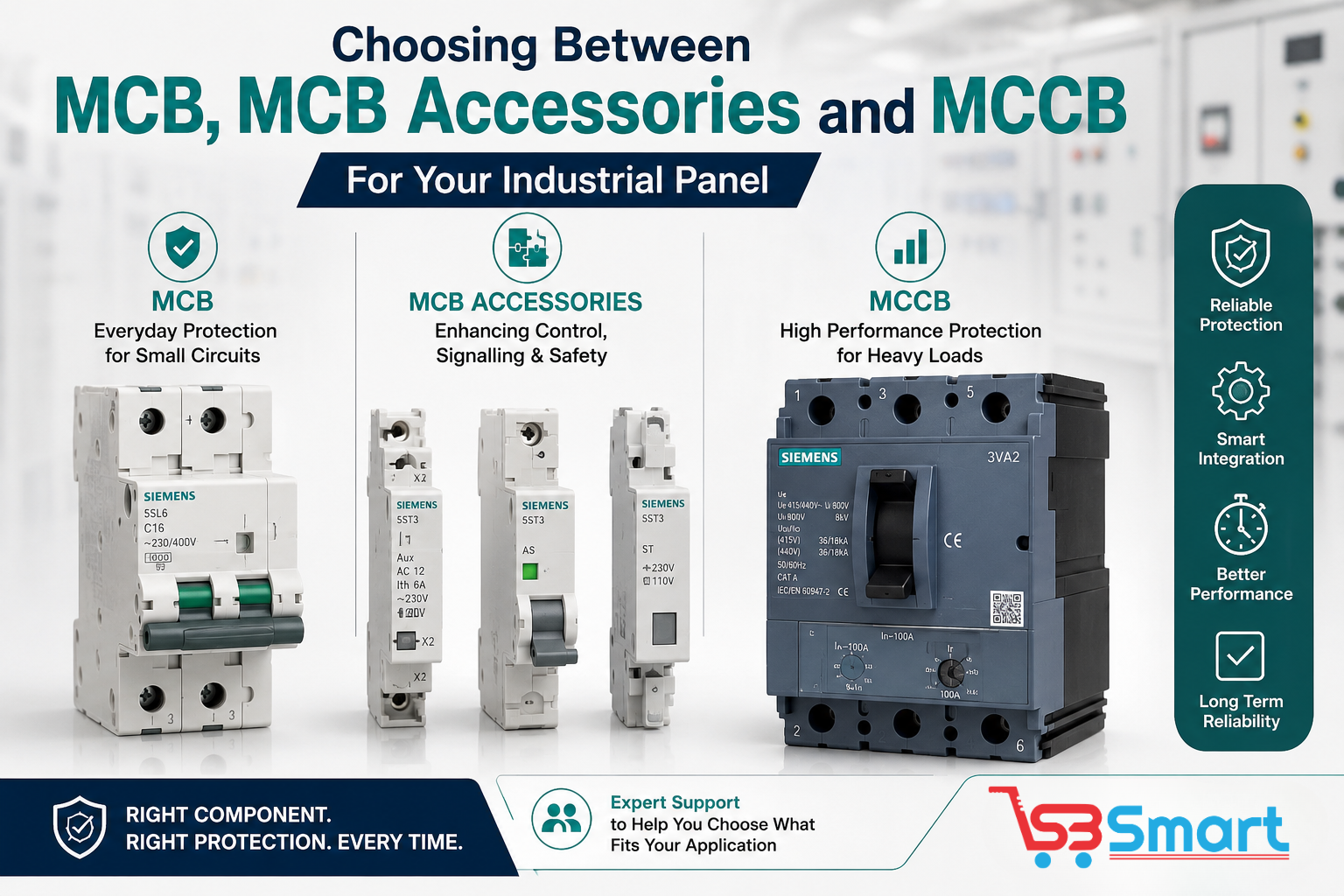
Anyone who's worked around electrical panels for a while has probably run into this moment: a circuit keeps tripping, or worse, doesn't trip when it should, and the first question everyone asks is "was this even the right breaker for this circuit?" More often than people expect, the answer is no — not because the product was faulty, but because it was never really matched to the job in the first place.
At SB Smart, this comes up in conversations with customers more than almost anything else. So instead of just listing specifications, let's actually talk through how these three components — MCB, MCB Accessories, and MCCB — fit into a panel, and how to think about choosing between them.
MCB: The Everyday Protector
A Miniature Circuit Breaker (MCB) is usually the first line of protection in smaller circuits — lighting, control wiring, small motors, distribution boards, that sort of thing. It's compact, easy to install, and does its job quietly in the background until it's actually needed.
The part people tend to skip over is that MCBs aren't all built the same way underneath. Some are designed to tolerate a brief surge — like the current spike when a motor starts up — without tripping unnecessarily. Others are more sensitive, built for circuits where you want the breaker to react fast. Neither type is "better," they're just suited to different situations. Installing the wrong one doesn't mean the MCB is defective, it just means the tripping characteristic wasn't matched to how the circuit actually behaves.
So before ordering an MCB, it's worth asking: what exactly is this protecting, and how does that load behave when it starts up or runs?
MCB Accessories: Making the MCB Part of a Bigger System
On its own, a basic MCB just switches a circuit on or off when something goes wrong. In a lot of real installations, that's not quite enough — which is where MCB Accessories come into play.
These accessories add capabilities the base MCB doesn't have — things like remote tripping, auxiliary contacts for signalling back to a control system, or fault indication. They're small components, but they're what turn a simple breaker into something that can actually talk to the rest of your panel.
The one thing our team at SB Smart always flags to customers is compatibility. An accessory made for one MCB series won't necessarily fit or work with a different one, even if they look similar on the shelf. It's a detail that's easy to miss until you're halfway through an installation and something doesn't sit right.
MCCB: Stepping Up for Bigger Loads
Once you're dealing with higher currents — larger motors, bigger distribution circuits, heavier equipment — an MCB simply isn't built for that scale anymore. That's the point where a Moulded Case Circuit Breaker (MCCB) takes over.
An MCCB handles a different range of the problem entirely. Beyond just higher current ratings, many MCCBs offer adjustable trip settings, which is genuinely useful — instead of being locked into one fixed protection point, you can tune it to match how your specific circuit actually operates.
Picking the right MCCB still comes down to more than the ampere rating though. Short-circuit breaking capacity, number of poles, and how it physically fits into your panel layout all matter just as much. It's not unusual to see a correctly rated MCCB cause installation problems simply because nobody checked the panel space beforehand.
Why This Actually Matters
None of these three work well in isolation. An MCB protects the smaller circuits, its accessories extend that protection into signalling and control, and an MCCB steps in wherever the load outgrows what an MCB can safely handle. Skip the planning on any one of these, and you end up with a panel that's harder to maintain, harder to troubleshoot, and more likely to fail at the worst possible time.
At SB Smart, we supply genuine Siemens MCBs, MCB Accessories, and MCCBs, sourced through verified channels. Whether you're building a new panel or replacing components in an existing one, getting the specifications right at the start saves a lot of trouble later — both for the person installing it and for whoever has to maintain it down the line.
If you're planning your next panel or need help figuring out what actually fits your application, SB Smart's team can walk you through it.
Explore the full range at sbsmart.in.