
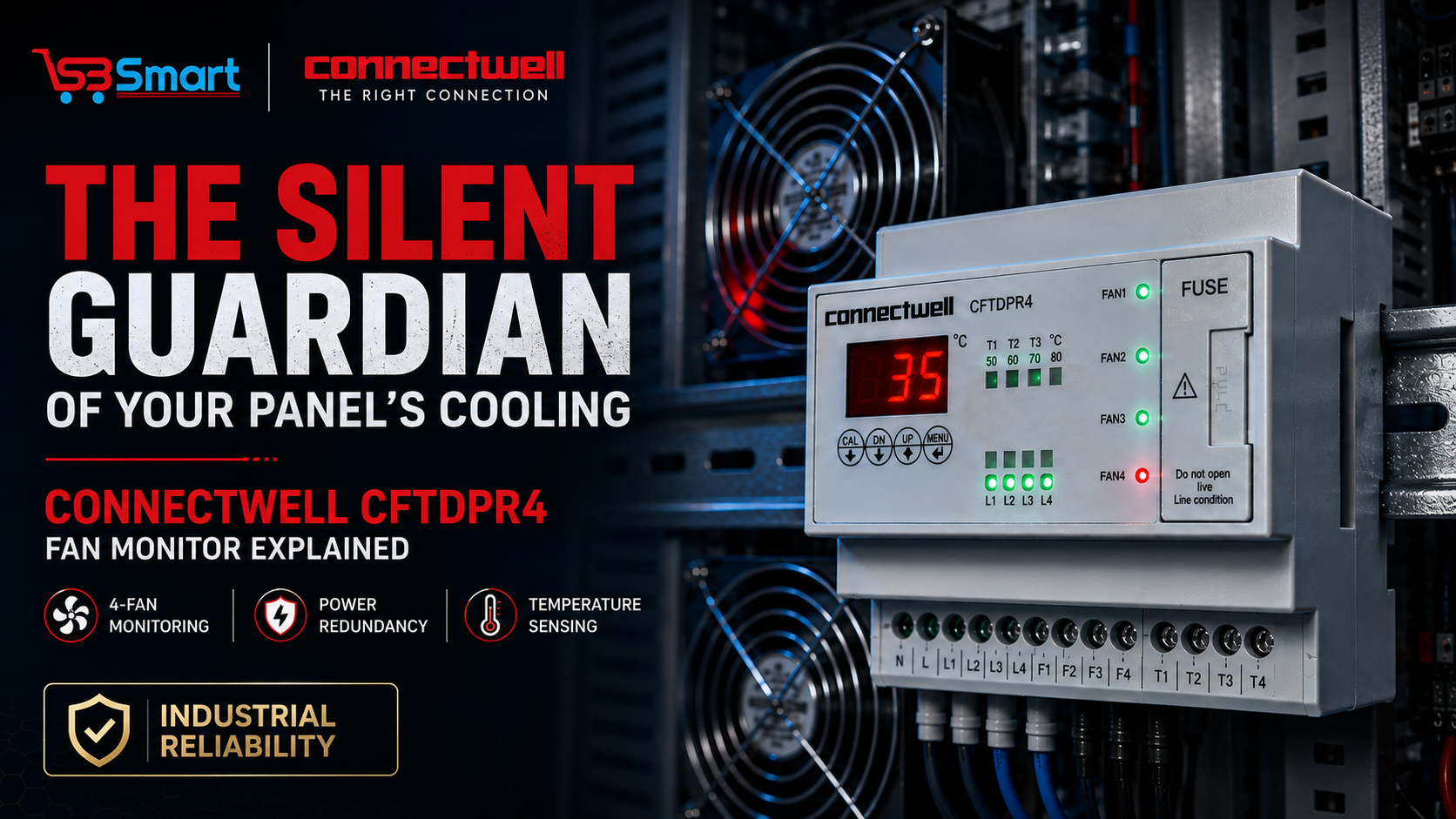
The Silent Guardian of Your Panel's Cooling: Connectwell CFTDPR4 Fan Monitor Explained
Panel cooling fans are one of those components nobody checks until the smell of hot electronics fills the room. A single stalled fan behind a VFD cabinet or a server rack can push internal temperatures up quietly, for hours, before anything trips or fails outright - and by then, the damage to sensitive components is often already done. The Connectwell CFTDPR4 exists specifically to close that blind spot, watching over not one but four fans simultaneously, with a level of redundancy built in that most basic fan monitors simply don't offer.
What the CFTDPR4 Actually Is
The CFTDPR4 is a fan failure monitoring module built to supervise four fans at once, combining current-based fan monitoring with temperature sensing and AC power redundancy in a single DIN-rail mounted device. It sits between the incoming supply and the cooling fans themselves, continuously watching how each fan is actually performing rather than just assuming it's running because it's powered. Where it stands apart from more basic fan monitors is the "PR" in its name - power redundancy. If the primary power feed to the fans fails, the module is designed to automatically switch over to a backup power source, keeping cooling airflow running through exactly the kind of event that would otherwise leave a cabinet quietly overheating.
How It Actually Monitors Fan Health
Rather than simply checking whether voltage is present at the fan terminals, the CFTDPR4 monitors the actual operating current draw of each connected fan. Each of the four fan channels can be individually programmed, and the module supports both autosensing and manual sensing modes - autosensing in particular saves a fair amount of setup time, since it can establish baseline current parameters for each fan automatically instead of requiring manual calibration for every channel. This current-based approach matters because a fan can fail in more than one obvious way. A blade that's mechanically seizing, a motor winding degrading, or a bearing wearing out often shows up as a shift in current draw well before the fan stops turning completely - catching that shift early is what separates a monitoring system from a simple "is it spinning or not" check.
Temperature Monitoring Built In, Not Bolted On
Alongside fan current monitoring, the CFTDPR4 includes a 3-wire RTD interface, letting it track the actual temperature inside the enclosure it's protecting rather than just inferring conditions from fan behaviour alone. The unit includes an onboard display for live temperature readout and programming, so technicians can check status directly at the panel without needing a separate handheld meter. For integration into a wider monitoring setup, the module also provides a 4-20mA current output (configurable as 2-wire), making it straightforward to feed live temperature data into a PLC, SCADA system, or building management platform alongside whatever else is already being monitored in that panel.
What Happens When Something Actually Goes Wrong
The CFTDPR4 is built to communicate faults clearly rather than fail silently. Onboard LED indicators show Fan OK, Fan Fail, Fuse Fail, and Fan Trip Set status at a glance, which matters a great deal during a walk-through inspection when a technician needs to spot a developing problem without pulling out documentation or a laptop. Beyond the visual indication, the module provides potential-free contacts for both fan fault and temperature fault conditions, meaning these signals can be wired directly into a facility's central alarm or control system rather than relying on someone physically noticing a blinking LED. There's also fan fuse protection built into the design, adding a layer of protection against fault conditions on the fan circuit itself.
Built for Real Panel Wiring
On the practical installation side, the CFTDPR4 uses screw-type terminal connections rated for wire sizes between 0.5 mm² and 2.5 mm² (20 AWG to 14 AWG), with M3 screw terminals and a 7mm wire stripping length - standard, panel-builder-friendly specifications that don't require special tooling or connectors. Each fan channel is rated for 230VAC or 110VAC operation at 25-750mA, and the module itself runs on a universal input voltage design covering 110-230VAC, so it adapts to different regional supply standards without needing a separate variant.
Where This Module Actually Earns Its Place
VFD and Drive Panels - Where cooling fan failure can directly shorten the life of power electronics running close to their thermal limits.
Data Centers and Server Rooms - Where redundant cooling with power backup is often a baseline requirement rather than an optional extra.
Telecommunications Infrastructure - Exchanges and equipment shelters that need to stay within safe operating temperature regardless of grid stability.
Process Automation and Control Panels - Where multiple cooling fans across a cabinet need centralized, single-point monitoring instead of individual, unmonitored units.
Power Electronics Enclosures - Rectifiers, inverters, and similar equipment where sustained heat buildup is one of the more common causes of premature component failure.
Frequently Asked Questions
How many fans can the CFTDPR4 monitor at once?
The CFTDPR4 monitors up to four fans simultaneously, with each channel individually programmable for its own fault detection parameters.
What makes the CFTDPR4 different from a standard 4-fan monitor like the CFTD4?
The CFTDPR4 adds AC power redundancy on top of standard fan and temperature monitoring, automatically maintaining cooling power even if the primary supply to the fans fails.
Does the CFTDPR4 monitor temperature as well as fan current?
Yes. It includes a 3-wire RTD interface for temperature sensing along with an onboard display, and it provides a 4-20mA analog output for feeding temperature data into external monitoring systems.
How does the module alert technicians to a fault?
Through onboard LED indicators for Fan OK, Fan Fail, Fuse Fail, and Fan Trip Set conditions, plus potential-free relay contacts for both fan fault and temperature fault, allowing remote alarm integration.
What input voltage does the CFTDPR4 support?
It uses a universal input voltage design covering 110-230VAC, with each fan channel rated for 230VAC or 110VAC at 25-750mA.
Is calibration required for each fan channel?
The module supports both autosensing, which automatically establishes baseline current parameters, and manual sensing for cases where specific thresholds need to be set by hand.
Sourcing a Genuine Connectwell CFTDPR4
A fan monitor is one of those components whose entire value lies in catching a fault before it becomes expensive - which means it needs to actually work correctly and consistently, not just look right on a spec sheet. Sourcing a genuine unit matters here just as much as it does for any other protective device sitting between a fault and a costly shutdown. You can check current availability and full specifications for the Connectwell CFTDPR4 Fan Monitor at SB Smart. If you have the exact product page link for this model, share it and it can be linked directly for readers.
The Bottom Line
Cooling fans rarely get a second thought until one stops working and something downstream starts overheating. The Connectwell CFTDPR4 is built for exactly that blind spot - watching four fans at once, tracking real operating current rather than just presence of power, keeping an eye on enclosure temperature, and stepping in with backup power if the primary feed fails. For panels where a cooling failure isn't just inconvenient but genuinely expensive, this is the kind of quiet, unglamorous protection that earns its place on the DIN rail.