
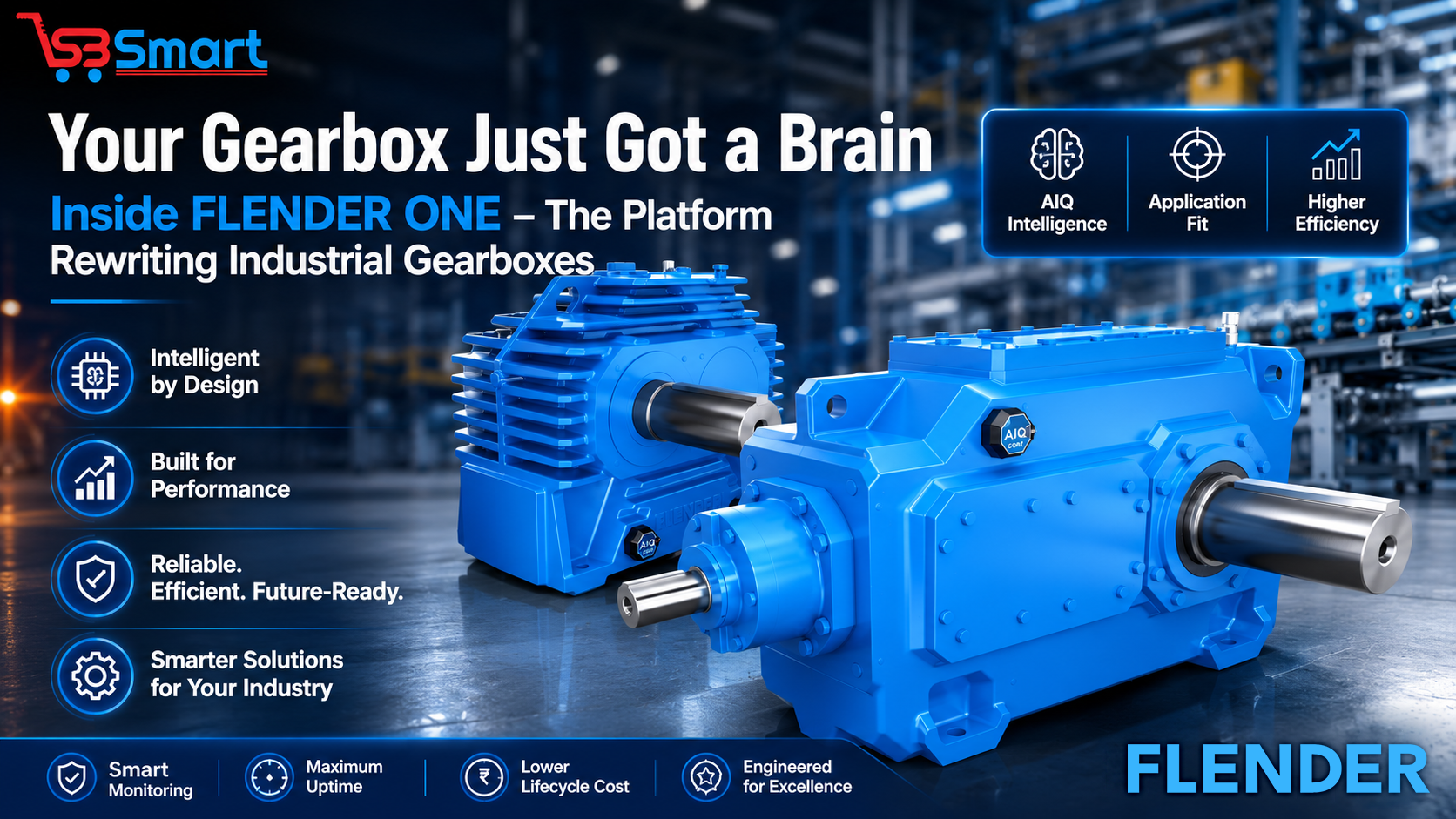
Your Gearbox Just Got a Brain: Inside FLENDER ONE, the Platform Rewriting What an Industrial Gearbox Can Do
For as long as gearboxes have existed in industrial plants, they have mostly done one job silently in the background - convert speed and torque, and stay out of the way until something breaks. Nobody walks past a gearbox and thinks about it, right up until the day it fails mid-shift and takes a production line down with it. FLENDER ONE is Flender's answer to changing that relationship entirely, and it does it by treating the gearbox not as a passive mechanical box, but as an intelligent, application-specific piece of the production line that actually reports back on its own health.
What FLENDER ONE Actually Is
FLENDER ONE is a new gearbox platform from Flender covering both single-stage and multi-stage industrial gearboxes, built to serve well over a hundred different industrial applications from a single, unified design architecture. Instead of separate product lines for different industries, FLENDER ONE is engineered so that one platform, configured differently, can handle everything from pumps and conveyor belts to bucket elevators, lifting equipment, and paper machine drives. The idea behind building it this way is simple - rather than forcing a customer to accept an oversized, generic gearbox that "should work" for their application, the platform lets each unit be configured to match the actual operating requirement closely, which Flender refers to as "application fit."
Built Individually, Not Off a Shelf
One of the more genuinely useful ideas behind FLENDER ONE is how much configuration flexibility is baked into the platform from the start. Whether the application is a bucket elevator running continuously in a mineral processing plant or a lifting mechanism in a port facility, the platform is designed to be configured around that specific duty rather than the customer adapting their process to fit a fixed gearbox size. This matters more than it sounds. An oversized gearbox does not just cost more upfront - it often runs less efficiently, wastes energy, and takes up more physical space than the application genuinely needs. By tailoring the configuration to the actual load and speed requirement, FLENDER ONE is built to cut down exactly this kind of waste, both in the initial design phase and across the gearbox's operating life.
Where the Efficiency Gains Actually Come From
Flender's own figures put the planning time savings at around 25 percent, largely thanks to a new configurator tool, immediately available 3D data, and shorter delivery timelines compared to the older process of custom-engineering a gearbox from scratch for each project. On the operating side, the platform is engineered for reduced power loss, translating into lower energy costs over the gearbox's working life - Flender cites an average of 20 percent lower power loss compared to its predecessor lineup. For a component that runs continuously for years in most industrial settings, that kind of ongoing energy saving adds up to a meaningful number well beyond the initial purchase price.
The Part That Makes This Genuinely Different: AIQ Gearbox Intelligence
This is arguably the most significant shift FLENDER ONE brings to the table. Every new FLENDER ONE gearbox ships from the factory with an AIQ Core Sensor already fitted, continuously monitoring speed, temperature, and vibration around the clock. Instead of waiting for a scheduled maintenance check or, worse, an unplanned failure, the system flags irregularities as they start to develop, evaluates the ongoing condition of internal components, and even assists with getting drive train alignment correct during commissioning. For maintenance teams, this shifts gearbox upkeep from a reactive, "fix it when it breaks" model toward a genuinely predictive one, where a developing issue gets caught while it is still a minor irregularity rather than a full breakdown.
Engineering Details Worth Knowing
A few of the more technical specifications that define what this platform is actually capable of:
- Nominal torque range: 1.9 kNm to 245 kNm, covering a wide span from smaller industrial applications up to genuinely heavy-duty drive requirements.
- Gear ratio density: The single-stage FLENDER ONE offers 103 gear ratios from i = 1.0 to i = 7.1 per size, which Flender describes as the densest gear ratio network available anywhere, with a "speed fit" accuracy of over 98.5 percent - in practical terms, this means finding a ratio that matches your actual required speed closely, rather than settling for the nearest available option.
- METAPERFORM gearing: A performance-optimized gear tooth design aimed at improving overall efficiency and load capacity within the same physical envelope.
- Reduced oversizing: Bearings and thermal performance have been re-engineered specifically so that oversizing - a common workaround in traditional gearbox selection - is no longer necessary, resulting in a unit that delivers strong performance while using fewer materials both in manufacturing and operation.
Where FLENDER ONE Actually Gets Used
The application range here is genuinely broad, which is part of the platform's core design philosophy. A few industries where it shows up:
Construction and Port Operations - Belt systems, hoists, and mixing/aeration equipment where reliable, continuous-duty drive performance is essential.
Chemical Processing - Mixers, agitators, aerators, and pumps operating in demanding process environments.
Power Generation - Blowers, fans, compressors, pumps, generator sets, and water turbines across power plants.
Food and Beverage - Belt lines, bucket elevators, conveyors, rollers, and mixing equipment where hygiene-conscious, reliable drives matter.
Metals Industry - Belt systems, conveyors, rolling mills, calenders, hoists, and winders in some of the most demanding continuous-duty environments in industry.
Minerals and Raw Materials - Conveyors, pumps, crushers, shredders, and compressors handling heavy, abrasive material flow.
Water and Wastewater Treatment - Mixers, aerators, pumps, generators, and turbines across municipal and industrial water infrastructure.
Pulp and Paper - Rolls, cylinders, compressors, mixers, mills, and calenders in paper production lines where consistent drive performance directly affects product quality.
The platform is also used in presses, chassis systems, positioning devices, machine tools, and even passenger cable car installations - a genuinely wide net that reflects the flexibility built into the design from the start.
An Award-Winning Design, Not Just a Functional One
The single-stage FLENDER ONE gearbox picked up an iF Design Award, and the recognition was not purely aesthetic. The distinctive ribbed exterior on the single-stage version is functional first - it increases surface area for cooling efficiency, directly supporting the platform's reduced power loss goals. Paired with Flender's signature blue finish and octagonal design elements, it marks what the company describes as the first real step in reinterpreting what an industrial gearbox looks like, inside and out.
Why This Matters If You're Specifying a Gearbox Right Now
If you are in the process of selecting a gearbox for a new installation or replacing an aging unit, the practical takeaway from FLENDER ONE is this: application-specific configuration and built-in condition monitoring are no longer premium add-ons reserved for large capital projects. They are becoming the standard way a well-engineered gearbox should work, and specifying a platform like this from the outset can mean fewer unplanned stoppages and a genuinely lower total cost of ownership over the equipment's working life, not just a lower price tag on day one. You can review the full FLENDER ONE range and configuration options through SB Smart. If you have a specific torque, ratio, or application requirement in mind, sharing those details directly is the fastest way to get an accurate configuration and quote rather than working from a generic listing.
The Bottom Line
FLENDER ONE is not simply a new model number added to an existing catalogue - it is a genuine rethink of how an industrial gearbox is designed, configured, and monitored once it's running. Between the application-fit configuration philosophy, real measurable efficiency gains, and AIQ intelligence built in from the factory floor, it represents exactly the kind of shift that turns a gearbox from a component you replace reactively into one that actively helps you avoid downtime in the first place.