
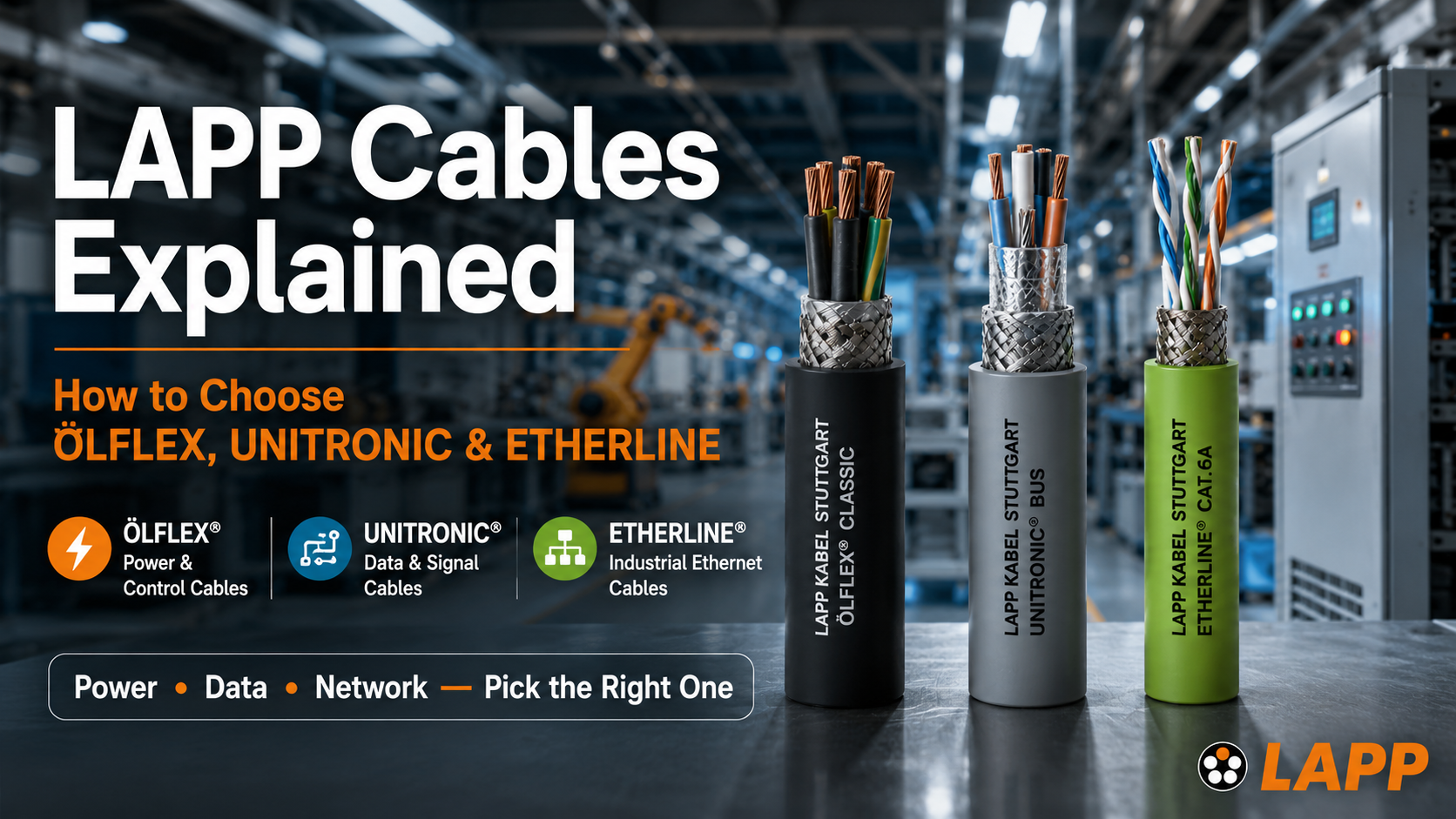
LAPP Cables Explained: How to Choose ÖLFLEX, UNITRONIC & ETHERLINE
If you've ever searched for industrial cables, you've probably come across the name LAPP — and along with it, three brand names that can feel a little confusing at first: ÖLFLEX, UNITRONIC, and ETHERLINE. New buyers often ask, "Aren't these all just cables? What's the actual difference?"
The truth is, each of these brands is built for a completely different job. Picking the wrong one can lead to signal loss, overheating, early cable failure, or even downtime on your production line. In this guide, we'll break down what each LAPP brand actually does, when to use which one, and how to choose the right cable for your specific application — all in simple, easy-to-understand language.
Who Is LAPP?
LAPP (also known as the LAPP Group, headquartered in Stuttgart, Germany) is one of the world's leading manufacturers of cables, wires, and connection technology. The company is known for pioneering the very first colour-coded control cable, and today its product catalogue covers everything from power cables to data cables to fibre optics, cable glands, connectors, and cable protection systems. LAPP organizes its massive product range under several distinct brand names, and understanding these brands is the fastest way to find exactly what you need.
The three most commonly searched LAPP brands are:
- ÖLFLEX® – Power and control cables
- UNITRONIC® – Data and bus communication cables
- ETHERLINE® – Industrial Ethernet cables
Let's go through each one in detail.
ÖLFLEX®: Power & Control Cables
ÖLFLEX is LAPP's flagship and most well-known brand — in fact, it holds the title of the world's first branded cable. As the name hints ("öl" is German for oil), ÖLFLEX cables are built to be highly oil-resistant, flexible, and durable, making them suitable for almost any industrial environment.
Key features of ÖLFLEX cables:
- Excellent flexibility, ideal for moving applications
- Strong resistance to oils, chemicals, and abrasion
- Available in halogen-free versions for safer environments
- Designed to handle a wide range of temperatures and outdoor conditions
- Special variants available for renewable energy applications like solar and wind
Common applications:
- Machine building and factory automation
- Robotics and moving machine parts
- Power supply wiring for motors and control panels
- Renewable energy installations
- Any application requiring flexible, tough power and control wiring
If your project involves supplying power or control signals to motors, machines, or panels — especially in tough or oily environments — ÖLFLEX is almost always the right family to look at.
UNITRONIC®: Data Communication Cables
While ÖLFLEX handles power, UNITRONIC is all about data. This brand is designed for fast, safe, and reliable transfer of information between devices, sensors, and controllers.
UNITRONIC cables aren't just simple data lines — many of them also function as bus lines, which means they can connect directly with sensors, actuators, and automation gateways. This makes UNITRONIC a core part of building smart, automated systems.
Key features of UNITRONIC cables:
- Reliable signal transmission with minimal interference
- Available in shielded and unshielded versions
- Compatible with various automation bus protocols
- Designed for continuous flexing (drag chain) applications where needed
- Strong performance in measurement and control systems
Common applications:
- Sensor and actuator wiring
- Industrial automation and control panels
- Bus and LAN network connections
- Measurement and regulation systems
- Machine-to-machine communication
If you're setting up communication between a PLC, sensors, and actuators, UNITRONIC is the go-to brand for keeping your signals clean and your system running smoothly.
ETHERLINE®: Industrial Ethernet Cables
ETHERLINE takes data communication one step further — it's specifically built for Ethernet-based networking in industrial environments. As factories increasingly rely on connected devices and real-time data exchange, ETHERLINE cables are designed to handle the demands of modern industrial networks.
Key features of ETHERLINE cables:
- Built for robust performance in demanding industrial settings
- Supports common industrial Ethernet protocols like PROFINET, EtherCAT, and Ethernet/IP
- Resistant to mechanical stress, vibration, and harsh conditions
- Available in various categories (such as Cat.5e, Cat.6, and Cat.7) to match your bandwidth needs
- Suitable for both fixed installations and continuous-flex applications
Common applications:
- Factory network backbones
- Connecting PLCs, switches, and industrial controllers
- Real-time automation networks
- Industrial IoT and smart factory setups
- Any environment where standard office Ethernet cables simply can't survive
If your facility relies on Ethernet-based industrial protocols to keep machines talking to each other in real time, ETHERLINE is built specifically for that job — standard consumer-grade Ethernet cables won't hold up in these tough conditions.
ÖLFLEX vs UNITRONIC vs ETHERLINE: Quick Comparison
| Feature | ÖLFLEX® | UNITRONIC® | ETHERLINE® |
|---|---|---|---|
| Main purpose | Power & control | Data & bus signals | Industrial Ethernet networking |
| Best for | Motors, machines, panels | Sensors, actuators, PLC wiring | Factory networks, IoT, automation protocols |
| Key strength | Flexibility & oil resistance | Reliable low-frequency data transfer | High-speed, protocol-specific networking |
| Typical users | Machine builders, panel builders | Automation engineers | Network & controls engineers |
How to Choose the Right LAPP Cable
Here's a simple way to decide which brand you need:
- Are you supplying power or controlling a motor/machine? → Go with ÖLFLEX.
- Are you connecting sensors, actuators, or a bus/measurement system? → Go with UNITRONIC.
- Are you building or extending an industrial Ethernet network? → Go with ETHERLINE.
- Still unsure or mixing multiple needs? Many industrial systems actually use all three together — ÖLFLEX for power, UNITRONIC for sensor wiring, and ETHERLINE for the network backbone. It's common to use them side by side in the same control panel or machine.
A Few Extra Tips Before You Buy
- Check the environment first. If the cable will be exposed to oil, chemicals, or constant movement (like in a drag chain), make sure you pick the "FD" (flexible/drag chain) variant where available.
- Match your protocol. For ETHERLINE cables, always confirm the cable category (Cat.5e, Cat.6, Cat.7) matches the bandwidth and protocol your network needs.
- Look for the right certifications. Depending on your industry and region, you may need cables that are UL listed, halogen-free, or meet specific flammability standards.
- Don't guess on cross-section or core count. Using an undersized cable for power applications can lead to overheating; consult the datasheet or a LAPP distributor to confirm the right specification for your load.
Final Thoughts
LAPP's brand structure might look confusing at first glance, but once you understand the purpose behind each name, it becomes very simple: ÖLFLEX powers your machines, UNITRONIC carries your signals, and ETHERLINE connects your network. Choosing the right one comes down to asking a simple question — what exactly does this cable need to carry: power, data, or network traffic?
Getting this right the first time saves you money, prevents downtime, and ensures your automation systems run reliably for years to come.
Frequently Asked Questions (FAQ)
Q1. What is the main difference between ÖLFLEX, UNITRONIC, and ETHERLINE? ÖLFLEX cables are used for power and control wiring, UNITRONIC cables are used for data and bus communication (like sensors and actuators), and ETHERLINE cables are specifically designed for industrial Ethernet networking.
Q2. Can I use a UNITRONIC cable instead of ETHERLINE for a network connection? No. UNITRONIC is designed for general data and bus signals, while ETHERLINE is purpose-built to support industrial Ethernet protocols like PROFINET and EtherCAT. Using the wrong cable type can lead to poor network performance or protocol incompatibility.
Q3. Are ÖLFLEX cables suitable for outdoor use? Many ÖLFLEX variants are designed to handle a wide range of environmental conditions, including outdoor and wet/dry environments. However, it's important to check the specific product's datasheet, as not all versions are rated the same way.
Q4. What does "FD" mean in LAPP cable names? "FD" typically refers to cables designed for flexible or drag chain (continuous-flex) applications. These cables are tested for a high number of bending cycles, making them suitable for moving machine parts.
Q5. Is LAPP the same company across ÖLFLEX, UNITRONIC, and ETHERLINE? Yes. ÖLFLEX, UNITRONIC, ETHERLINE, along with brands like HITRONIC, SKINTOP, EPIC, SILVYN, and FLEXIMARK, are all part of the LAPP Group's product family, covering everything from cables to connectors to cable protection systems.
Q6. Which LAPP cable do I need for connecting sensors to a PLC? UNITRONIC cables are the standard choice for wiring sensors, actuators, and other bus-connected devices back to a PLC or automation controller.
Q7. Do I need a special cable for drag chains and moving machine parts? Yes — look for ÖLFLEX or UNITRONIC variants specifically rated for continuous-flex or drag chain use. These are tested for millions of bending cycles to ensure long-term reliability in moving applications.
Q8. How do I know which Ethernet category (Cat.5e, Cat.6, Cat.7) I need from the ETHERLINE range? This depends on your required data speed, network protocol, and cable length. Higher categories generally support faster data rates and better shielding — check your automation system's specification or consult a LAPP distributor to confirm the right match. visit sbsmart for more information