
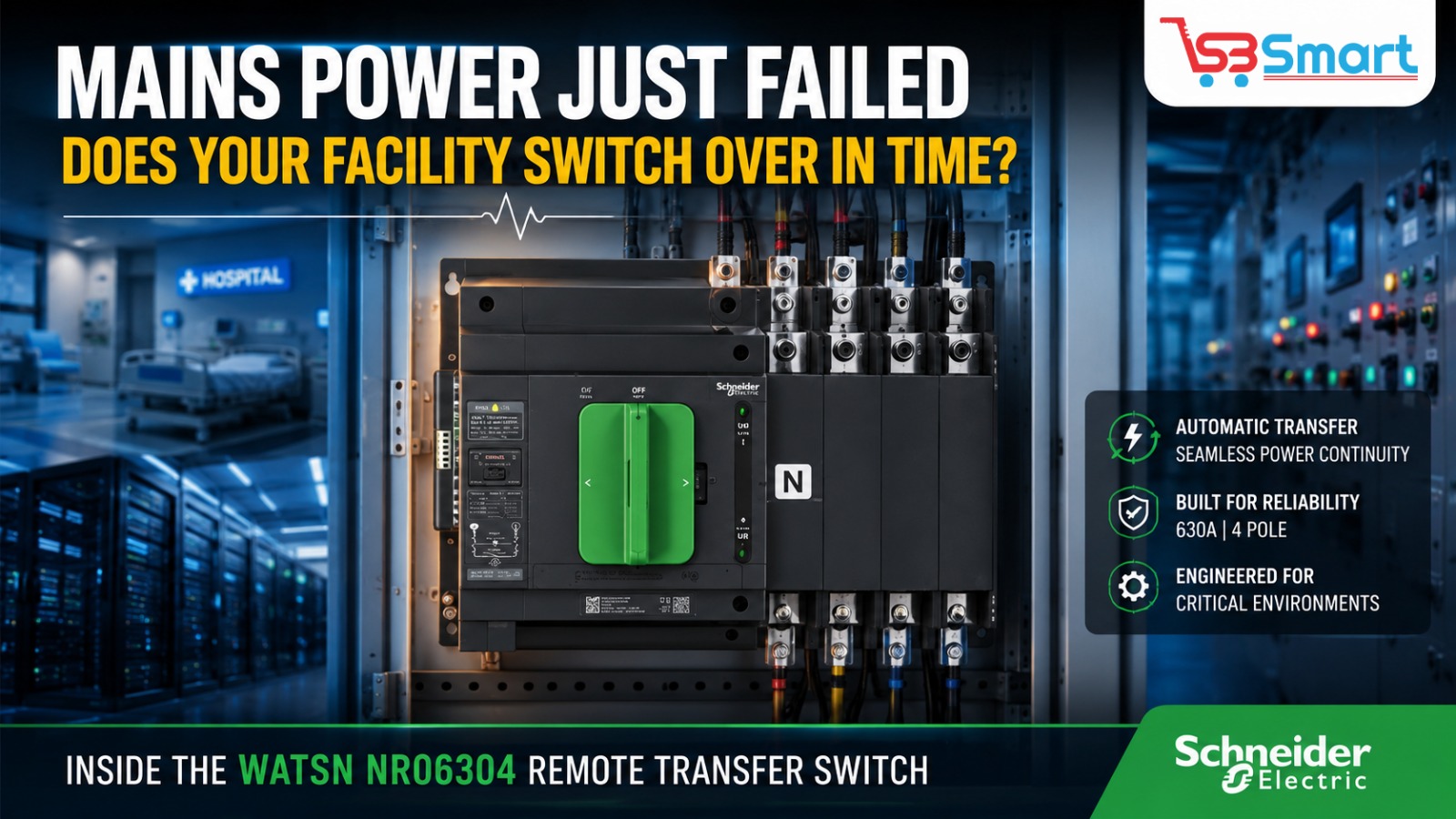
Mains Power Just Failed - Does Your Facility Switch Over in Time? Inside the WATSN NR06304 Remote Transfer Switch
Walk into any hospital ICU, server farm, or production floor at the exact second the grid drops out, and you will notice the same thing every time - a brief, uneasy pause where nothing seems to be happening. Ventilators, servers, control systems, running motors - all of it sits waiting on one piece of equipment tucked away in the electrical room to make the next move. That piece of equipment, in a growing number of Indian facilities, is the WATSN NR06304 Remote Transfer Switch.
Anyone tasked with selecting or replacing changeover gear for a site where downtime simply cannot happen owes it to themselves to understand this switch beyond the spec sheet - what it is built to do, how it is engineered, and where exactly it belongs in a real electrical system.
Getting to Know the NR06304
Technically speaking, the NR06304 belongs to a category called remote transfer switches, shortened in the industry to RTSE - Remote Transfer Switching Equipment. Where a manual changeover switch waits for a human to physically pull a lever, this unit takes its instructions remotely, from a PLC, a generator control panel, a SCADA network, or a Building Management System. In effect, the decision to move over to a second power source gets made the instant a fault is detected, by a control system, with nobody needing to sprint to the switchroom.
That distinction carries real consequences. A short delay during a manual changeover inside a hospital can be the difference that actually counts. Inside a data centre, it separates a graceful failover from a hard server crash. Inside a telecom exchange, it is what stands between an uninterrupted call and a dropped one.
What's Actually Under the Hood
None of the numbers on this switch's datasheet are there just to tick a compliance box - each spec explains a piece of how it behaves once installed and working.
630A Rated Current - Firmly a heavy-duty rating, meant for substantial building or plant-level loads rather than a small backup circuit or a single equipment rack.
4-Pole, 3P+N Configuration - All three phases plus the neutral get switched together. That last part - the neutral - is often overlooked, but it matters considerably whenever the two power sources do not share a common earth reference, as is often the case between mains and a standby generator. Skip proper neutral switching and you invite circulating currents or neutral imbalance that slowly damages connected equipment. Full 4-pole switching removes that risk from the equation entirely.
400V AC Rating - Sits right in line with standard Indian three-phase industrial supply, meaning it drops straight into typical LT distribution setups with no special transformer or adaptation needed.
Three-Position Design (Source I – OFF – Source II) - Easy to gloss over on paper, but arguably the single most important safety feature built into this switch. The middle OFF position makes it physically impossible for both sources to connect at once, and it doubles as a genuine isolation point whenever maintenance staff need to work on the panel safely.
Class PC Build Standard - This classification signals the switch is engineered for a long working life across repeated switching cycles, not a component meant for the occasional, once-in-a-while transfer.
Open Transition Operation - The switch disconnects from one source before making contact with the other, leaving a short power gap during transfer. This is expected, standard behaviour for this switch class, and it is exactly what guarantees the two sources are never connected together at the same time.
IEC 60947-6-1 Certified - This is the international standard written specifically for automatic transfer switching gear, and meeting it confirms the NR06304 has been tested against safety and performance benchmarks built for this exact job, rather than a general switch adapted to fit.
Real Places This Switch Shows Up
"Critical power application" sounds vague until you attach real buildings and real consequences to it.
Data Centres - A two-second power gap here can mean a crashed server, corrupted data mid-transaction, or a hard conversation about a broken SLA.
Hospitals - ICUs, operating theatres, and diagnostic equipment simply cannot absorb an uncontrolled power interruption, which is exactly why hospital electrical codes usually mandate automatic, verifiable transfer switching of this kind.
Telecom Sites - Exchanges and base stations that must remain live regardless of grid stability, frequently running on a mains-generator or mains-battery pairing.
Industrial Production Lines - An uncontrolled dip in power can ruin an in-progress batch, and restarting a process line from scratch often costs more than the downtime itself ever would.
Commercial Complexes with Backup Generators - Malls, IT parks, and large commercial developments where the facility management system needs to talk directly to the transfer switch instead of depending on someone showing up to operate it by hand.
Why "Remote" Isn't Just a Marketing Word Here
Plenty of buyers weigh a remote transfer switch against something simpler - a manual or basic automatic changeover - and wonder if paying for the extra integration is worth it. The honest answer depends entirely on how the site is actually managed day to day.
If there is always someone physically present and no centralised monitoring in place, a simpler switch may genuinely suffice. But the moment a facility runs on remote monitoring, operates unattended overnight, or ties into a broader building or plant-wide control system, a remote transfer switch stops being a convenience and becomes an operational necessity. It lets a control system view switch status in real time, log every transfer event for audit purposes, and in many installations, initiate the transfer automatically the moment power-quality sensors elsewhere flag a problem.
Before You Finalise the Order
- Confirm your panel builder has planned for the physical size and mounting depth of a 630A, 4-pole switch - it is noticeably bulkier than a standard MCCB of comparable rating.
- Check the exact control voltage and signal type your PLC, generator controller, or BMS is expecting, so the remote wiring works correctly from day one rather than needing rework.
- Decide whether the application genuinely calls for open transition switching, as this unit provides, or whether a specific process actually needs closed transition instead - the two are not interchangeable.
- Plan for the auxiliary contacts and status-signalling your monitoring system needs, so the switch's position is reported back accurately at all times.
Buying a Genuine Unit
At a 630A rating, a transfer switch failure is never a small inconvenience - it can mean the whole facility loses power at precisely the moment backup was supposed to step in. That single fact is why sourcing a genuine, properly certified unit matters far more here than it does for smaller electrical components.
You can check current stock and full technical specifications for the WATSN NR06304 Remote Transfer Switch at SB Smart. For projects spanning several switch ratings or a complete generator backup panel build, sending across the single line diagram or full panel BOM is generally the fastest way to get accurate pricing for the whole system rather than pricing each switch on its own.
Where This Leaves You
A remote transfer switch is easy to forget about - right up until the day mains power actually goes down, at which point it instantly becomes the single most critical piece of equipment in the building for the next few minutes. The WATSN NR06304, built around its 630A rating, complete 4-pole switching, and IEC-certified Class PC construction, exists specifically for facilities where that moment cannot be left to luck - hospitals, data centres, telecom sites, and industrial plants where uninterrupted power is a hard requirement, not a nice-to-have.
Getting the specification right at the design stage, and choosing a genuine, properly certified unit, is what separates a line item on a drawing from equipment you can actually count on the day it matters.