
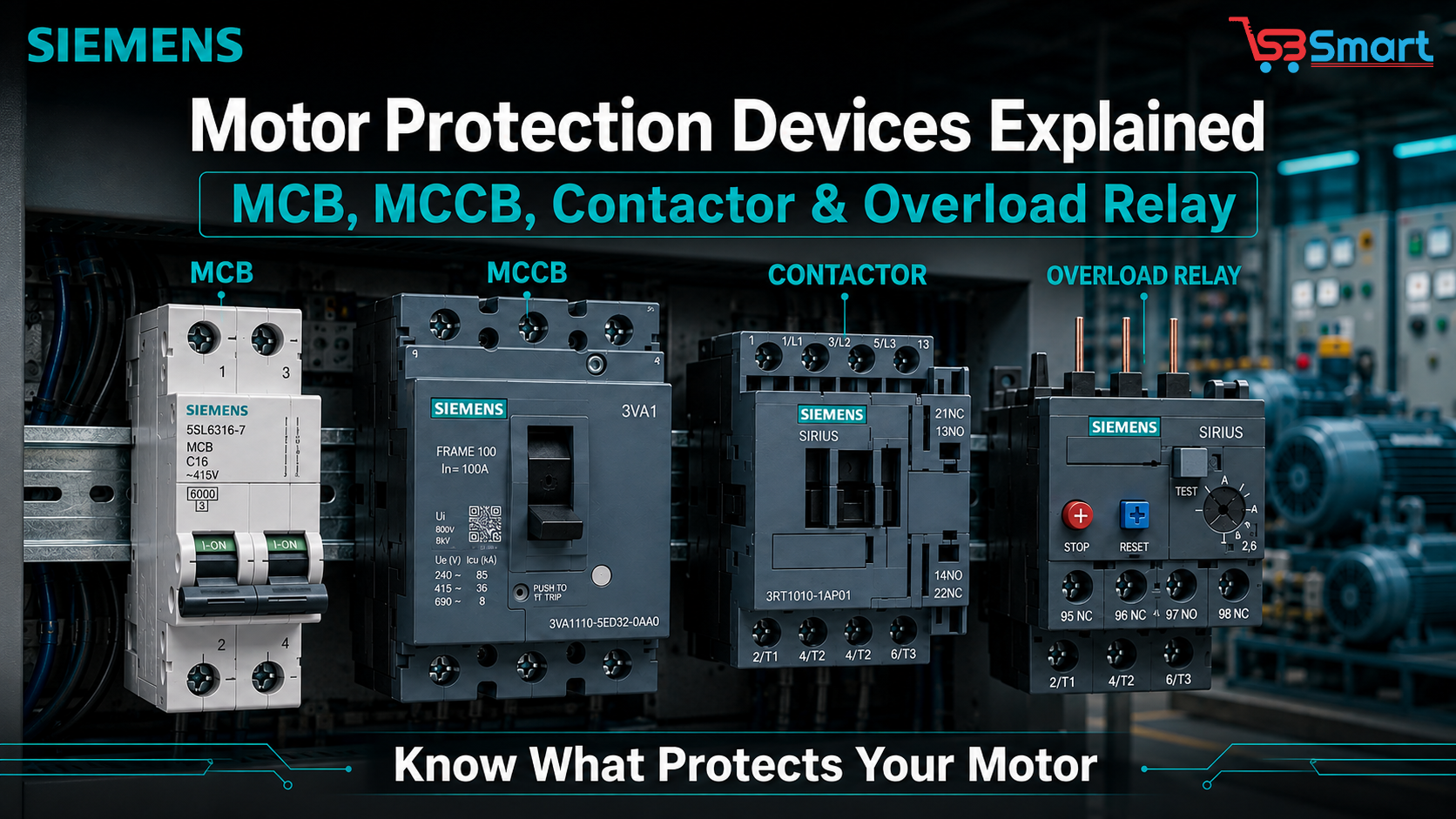
Motor Protection Devices: MCB, MCCB, Contactor & Overload Relay Explained
Walk up to any industrial control panel and you'll see a lineup of devices that all seem to be doing roughly the same thing — protecting a motor. But ask someone to explain exactly what an MCB does versus a contactor, or why you'd need both an MCCB and an overload relay on the same circuit, and things get fuzzy fast. It's one of the most common points of confusion for anyone newer to panel building or industrial electricals.
This guide breaks down each of these four devices — MCB, MCCB, contactor, and overload relay — in plain language, so you understand not just what they are, but exactly what job each one is doing in your motor circuit.
Why Motor Protection Needs More Than One Device
A motor is vulnerable to several different kinds of electrical faults — short circuits, overloads, single-phasing, and normal switching wear — and no single device handles all of them well. That's why a proper motor control circuit almost always uses a combination of devices, each specializing in one type of protection or function. Think of it less like one guard and more like a team, where each member watches for a different threat.
MCB — Miniature Circuit Breaker
An MCB is an automatic switching device that protects a circuit from overcurrent and short circuits. It works by physically breaking the circuit when current exceeds a set threshold, protecting the wiring and connected equipment from damage.
MCBs are typically used for lower current ratings (usually up to 63A or so) and are common in lighting circuits, small power circuits, and control circuits rather than large motor loads. They're compact, resettable after a trip, and simple to install on a DIN rail.
Where it fits: MCBs are generally used for smaller loads and control circuits — not typically the primary protection for larger three-phase motors, where an MCCB usually takes over.
MCCB — Moulded Case Circuit Breaker
An MCCB does a similar core job to an MCB — protecting against overcurrent and short circuits — but it's built for much higher current ratings and larger power distribution needs, often ranging from 16A up to several thousand amps depending on the frame size.
MCCBs typically offer adjustable trip settings, letting you fine-tune the current threshold and time-delay characteristics to match your specific motor or load — something a basic MCB usually can't do. This makes MCCBs the go-to choice for protecting larger motors, feeders, and distribution boards where precise coordination with downstream devices matters.
Where it fits: MCCBs are the primary short-circuit and overcurrent protection device for medium-to-large motors and distribution circuits, usually positioned right at the incoming supply to a motor circuit or panel section.
Contactor — The Switching Workhorse
A contactor is an electrically operated switch used to start and stop a motor (or other load) — but unlike an MCB or MCCB, its job isn't protection, it's repeated switching. Contactors are built to handle frequent on/off operations reliably, controlled remotely through a control circuit (a PLC output, a relay, a pushbutton).
Contactors are rated by utilization category — AC-1 for resistive loads, AC-3 for standard motor starting and stopping, and AC-4 for frequent starting, reversing, and jogging. Choosing the wrong category for your load type is one of the most common contactor mistakes, often leading to premature contact wear or welding.
Where it fits: A contactor is the device that actually turns your motor on and off, day in and day out, based on commands from your control system — it doesn't provide overload or short-circuit protection on its own.
Overload Relay — The Motor's Personal Bodyguard
An overload relay monitors the current drawn by a motor and trips the connected contactor if that current stays too high for too long — protecting the motor from overheating due to mechanical jams, prolonged overloading, or phase loss.
Unlike an MCB or MCCB, which react to sudden, large overcurrent events, an overload relay is tuned to catch sustained, moderate overcurrent — the kind of slow-building heat damage that would otherwise cook a motor's windings without ever tripping a breaker. Overload relays come in thermal (bimetallic) and electronic variants, with adjustable trip classes (10, 20, 30) matched to how quickly or slowly your load starts.
Where it fits: The overload relay works hand-in-hand with the contactor — it doesn't switch the motor itself, but it tells the contactor when to disconnect the motor to prevent damage.

How They All Work Together
In a typical motor control circuit, here's roughly how these four devices line up:
- MCCB (or MCB for smaller loads) — Positioned at the circuit's incoming supply, protecting against short circuits and severe overcurrent.
- Contactor — Positioned downstream, handling the actual switching of the motor on and off based on control signals.
- Overload Relay — Paired directly with the contactor, continuously monitoring current and tripping the contactor if the motor draws too much current for too long.
Together, this combination — sometimes called a DOL (Direct-On-Line) starter in its simplest form — gives you short-circuit protection, reliable switching, and overload protection, each handled by the device best suited for that specific job.
A Simple Way to Remember the Difference
- MCB/MCCB — Protects against sudden, severe faults (short circuits, big overcurrent spikes)
- Contactor — Switches the motor on and off, again and again, reliably
- Overload Relay — Watches for slow, sustained overcurrent and protects the motor from cooking itself
If you only remember one thing from this guide, it's this: protection devices (MCB/MCCB, overload relay) prevent damage, while the contactor is purely the switching device that makes the motor run in the first place.
Why Choosing the Right Combination Matters
Skipping or mismatching any one of these devices creates a gap in your motor's protection. An MCCB alone won't catch a slow-building overload. A contactor alone offers zero protection — it'll happily keep running a motor into failure if nothing tells it to stop. And an overload relay without a properly rated contactor has nothing to actually trip. Getting the combination and sizing right, from day one, is what keeps a motor circuit running for years instead of becoming a recurring maintenance problem.
Frequently Asked Questions (FAQ)
1. What is the main difference between an MCB and an MCCB? An MCB is used for lower current ratings and simpler circuits, while an MCCB handles much higher current ratings and offers adjustable trip settings, making it suitable for larger motors and distribution circuits.
2. Does a contactor provide overload protection on its own? No, a contactor is purely a switching device. Overload protection is provided by a separate overload relay paired with the contactor.
3. Why do I need both an MCCB and an overload relay if both are protective devices? An MCCB protects against sudden short circuits and severe overcurrent, while an overload relay protects against slow, sustained overcurrent — they cover different types of faults.
4. What is a DOL starter? A DOL (Direct-On-Line) starter is a basic motor control setup combining a circuit breaker (MCB/MCCB), a contactor, and an overload relay to safely start and protect a motor.
5. How do I choose the right contactor duty class? Match the contactor's utilization category to your load type — AC-1 for resistive loads, AC-3 for standard motor starting, and AC-4 for frequent starting, jogging, or reversing applications.
6. What happens if I skip the overload relay in a motor circuit? Without an overload relay, a motor can continue running under a sustained overload condition, leading to overheating and potential winding damage that a circuit breaker alone won't catch in time.
7. Can an MCB be used for large motor protection instead of an MCCB? Generally no — MCBs are designed for lower current ratings and simpler circuits, while MCCBs are built for higher currents and offer the adjustable settings needed for larger motor protection.
8. Where can I buy genuine MCBs, MCCBs, contactors, and overload relays in India? SB Smart supplies genuine Siemens and other branded MCBs, MCCBs, contactors, and overload relays, with GST invoicing, technical support, and PAN India delivery.
Final Thought
Motor protection isn't about picking one impressive-sounding device and hoping it covers everything — it's about understanding what each device actually does and making sure all four work together as a team. Once you see the MCB/MCCB, contactor, and overload relay as specialists rather than substitutes for one another, choosing and wiring the right combination for your motor circuit becomes a lot more straightforward.