
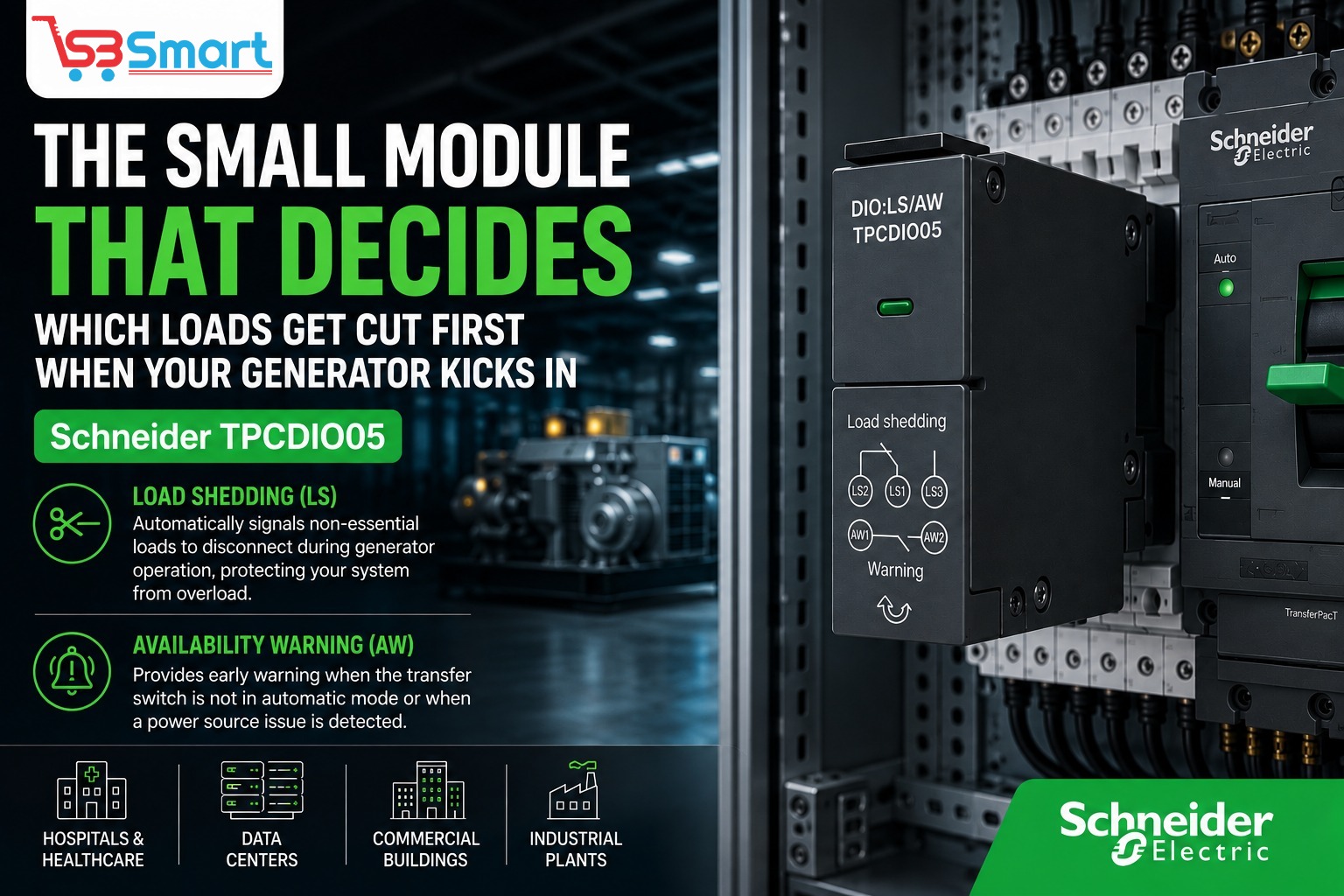
The Small Module That Decides Which Loads Get Cut First When Your Generator Kicks In: Schneider TPCDIO05
Every facility running on a generator backup eventually faces the same question during a mains failure: the generator can start and take over the load just fine, but can it actually carry everything the building was pulling from the grid a moment ago? In most real installations, the answer is no - not without shedding something. This is exactly the gap the Schneider Electric TPCDIO05 is built to close, quietly and automatically, inside a TransferPacT system.
It is a small accessory module, easy to overlook next to the transfer switch itself, but it ends up doing some of the most important decision-making in the whole backup power sequence.
What the TPCDIO05 Actually Is
The TPCDIO05 is a dedicated function module built specifically for Schneider's TransferPacT Active Automatic and TransferPacT Automatic ATS ranges. It does not switch power itself - that job stays with the transfer switch - but it adds two capabilities that a standard ATS does not have on its own: Load Shedding (LS) output signals and Availability Warning (AW) output signals. In plain terms, it gives the transfer switch a way to talk to the rest of the electrical system about what is happening, beyond simply which source is currently connected.
Load Shedding - Why It Matters More Than People Expect
When mains power goes down and a generator picks up the load, the generator is almost always sized for the essential loads only, not for absolutely everything the building normally runs. If every single circuit stays energised the moment the transfer happens, an undersized or already-loaded generator can overload, trip, or shorten its own service life through repeated stress. The Load Shedding output on the TPCDIO05 solves this by automatically signalling non-essential loads to disconnect the moment the system switches to generator power. Air conditioning in non-critical areas, decorative lighting, non-essential equipment - these get shed first, while the loads that actually matter (life-safety systems, critical process equipment, essential lighting) stay powered without interruption. This is not a manual process during an emergency. It happens automatically, driven by the transfer switch's own operating state, which is exactly what you want in the middle of a power event when nobody has time to walk around switching off breakers.
Availability Warning - Catching Problems Before They Become Outages
The second function built into this module is just as important, though it works in the opposite direction. Rather than reacting to a transfer event, the Availability Warning output keeps watch on the health of the transfer system itself. It generates a warning signal in two specific situations: when the transfer switch has been taken out of automatic mode (meaning it will not respond to a power failure the way it is supposed to), or when there is a genuine issue with the availability of one of the power sources. Both of these are the kind of problems that, left unnoticed, turn what should have been a smooth automatic transfer into a facility-wide outage - not because the switch failed, but because it was quietly sitting in the wrong mode or a source was already compromised before the failure even happened. By feeding this warning signal into a BMS or SCADA system, facility teams get visibility into these conditions well before an actual mains failure puts the system to the test.
Where This Module Fits Into a Real Installation
The TPCDIO05 is designed to integrate directly with TransferPacT Active Automatic and TransferPacT Automatic ATS units, which makes it relevant to any facility already using or specifying these Schneider transfer switch ranges. A few settings where it earns its place:
Hospitals and Healthcare Facilities - Where load shedding needs to be precise and automatic, keeping life-safety circuits live while non-critical loads step aside without anyone needing to intervene manually during an emergency.
Data Centers - Where availability warnings feeding into a monitoring system give facility engineers advance notice of a transfer switch sitting in manual mode or a power source issue, long before it becomes a live incident.
Commercial Buildings with Generator Backup - Malls, office parks, and mixed-use developments where generator capacity is often tightly sized against expected critical load, making automatic shedding of non-essential circuits genuinely necessary rather than optional.
Industrial Plants - Where certain processes must stay running through a power event while others can tolerate a pause, and manually deciding which is which during an actual outage is not realistic.
Why Add This Module Instead of Handling It Elsewhere
Some facilities try to achieve similar outcomes with separate relays, standalone monitoring devices, or manual procedures layered on top of the transfer switch. This usually works, up to a point, but it also means more points of failure, more wiring to maintain, and more room for something to be missed during a routine inspection. Building the load shedding and availability warning functions directly into a module designed for the TransferPacT platform means the signals are generated based on the transfer switch's actual internal state, not an external guess at what the switch is doing. That tends to be more reliable in practice, and it keeps the overall panel design simpler for whoever has to maintain it five years down the line.
A Few Things Worth Checking Before You Order
- Confirm which specific TransferPacT ATS model is already installed or specified, since the TPCDIO05 is built for the Active Automatic and Automatic series specifically.
- Check how the LS and AW output signals will be wired into your existing BMS, SCADA, or PLC system, so the integration is planned before the panel is built rather than worked out on-site.
- Decide which loads in your facility actually qualify as non-essential for shedding purposes - this is a design decision that needs input from facility management, not just the electrical contractor.
- Factor this module into the panel BOM early, since accessory modules like this are easy to forget until the main switch has already been ordered.
Sourcing a Genuine TPCDIO05
As with any accessory tied directly into a critical power transfer system, sourcing a genuine Schneider Electric unit matters. A counterfeit or mismatched accessory module can fail to communicate correctly with the ATS, which defeats the entire purpose of adding it in the first place. You can check current availability and specifications for the Schneider Electric TPCDIO05 at SB Smart. If you have the exact product page link for this part, share it and it can be dropped directly into this article so readers land straight on the correct listing. For panels involving the full TransferPacT range along with accessories like this one, sharing your panel BOM is usually the fastest way to get accurate, complete pricing.
The Bottom Line
The TPCDIO05 is not the part of the system anyone notices first - that credit goes to the transfer switch itself. But it is the module quietly deciding which loads get cut when the generator takes over, and the one keeping an eye on whether the whole transfer system is actually ready to respond when mains power fails. For facilities where getting that decision wrong means either an overloaded generator or an undetected fault sitting unnoticed until it is too late, this small accessory ends up mattering a great deal more than its size suggests.