
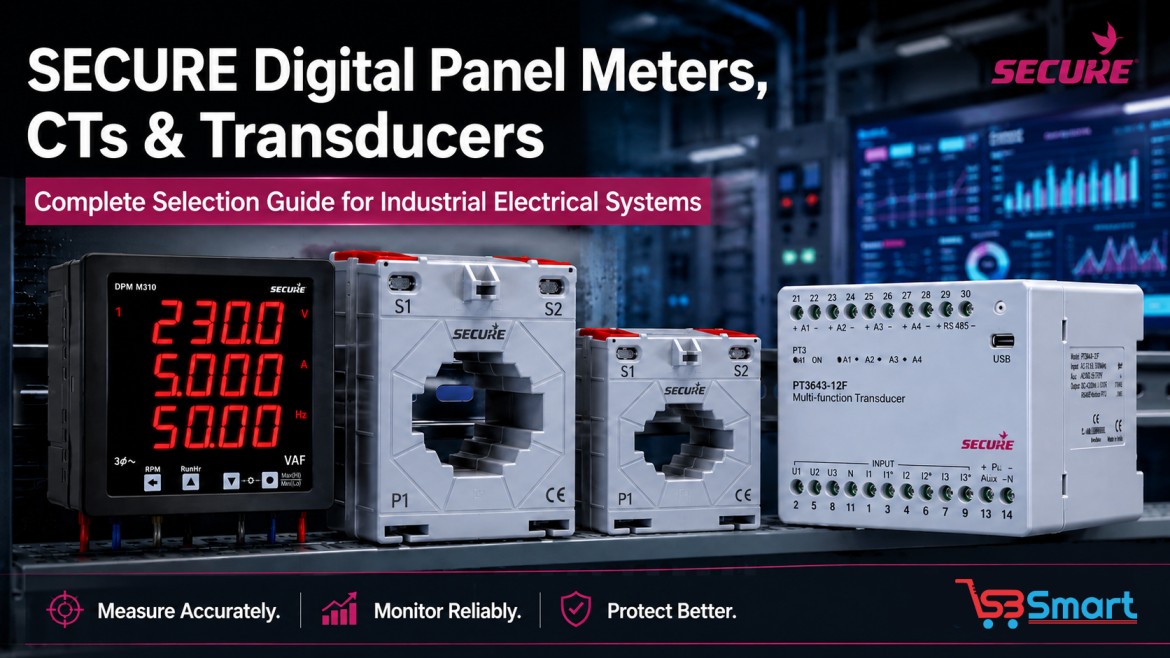
SECURE Digital Panel Meters, CTs & Transducers: Complete Selection Guide for Industrial Electrical Systems
Every well-run industrial facility has one thing in common — someone, somewhere, always knows exactly what the electrical system is doing. Not guessing, not estimating from last month's bill, but actually knowing the current, voltage, power factor, and energy consumption in real time. That visibility doesn't happen by accident. It's built on a specific stack of measurement devices: panel meters, current transformers (CTs), and transducers, each doing a distinct part of the job.
This guide walks you through SECURE's core measurement product range — what each device type does, how they connect to each other, and how to pick the right combination for your panel or plant.
Why Measurement Devices Deserve More Attention Than They Get
It's easy to treat metering as an afterthought in panel design — something added at the end once the "real" switchgear is specified. But inaccurate or missing measurement data has real consequences: billing disputes from incorrect sub-metering, protection systems that can't react properly because they're not getting accurate current data, and automation systems that make bad decisions because the signal feeding them was never right to begin with.
Getting this part of your panel right starts with understanding three core device types and how they work together.
Digital Panel Meters — The Display and Data Hub
A digital panel meter reads electrical parameters — current, voltage, power, energy — and displays them directly, often while also making that data available for billing, monitoring, or further integration.
The SECURE MCT74-40(45) Digital Energy Meter is a good example of this category. It's built to measure active energy (kWh) directly using current inputs in the 40-45A range, making it well suited for sub-metering and energy billing applications where you need a reliable, direct read of consumption. Panel meters like this sit at the front line of energy visibility — the device an engineer or facility manager actually looks at to know where power is going.
Where it fits: Anywhere you need a direct, readable measurement — sub-metering individual loads, billing tenants or departments, or simply keeping an eye on a specific circuit's consumption.
Current Transformers (CTs) — Scaling Current Down Safely
Before any meter can read a large current safely, that current usually needs to be scaled down to a manageable, standardized value. That's the job of a Current Transformer.
The SECURE MCT62-30(40) Current Transformer is a low voltage CT with a 60/5A current ratio and Accuracy Class 1.0, built in a compact 62 x 30 x 40 mm ring-type design. It doesn't display or process anything on its own — it simply takes the high current passing through a busbar or feeder and hands off an accurate, scaled-down secondary current to whatever meter or protection device is reading it.
Where it fits: Any application where raw current needs to be safely scaled down before feeding a meter, relay, or protection device — which is to say, almost every serious metering setup starts here.
For a deeper breakdown of exactly how CTs differ from transducers and when to use each, see our Current Transformer vs Transducer guide.
Transducers — Turning Measurements into Automation-Ready Signals
Where a panel meter displays data and a CT scales current down, a transducer does something different: it converts an electrical parameter into a standardized analog signal that a PLC, SCADA system, or DCS can directly use for automated decision-making.
The SECURE PT3 X43-155 Three-Phase Current Transducer measures True RMS AC current and converts it into 4 galvanically isolated analog outputs, with configurable input and output ranges set through USB-based ConfigView software — built specifically for direct integration into automation systems rather than just human-readable display.
Transducers aren't limited to current, either. The SECURE PT3 X43-128 Power Factor Transducer measures power factor at Accuracy Class 0.2, again outputting that reading as 4 isolated analog signals for PLC, SCADA, or energy management platform integration. This matters a lot in facilities running power factor correction — accurate, continuous power factor feedback is what keeps an APFC panel making the right switching decisions.
Where it fits: Anywhere your measurement data needs to feed directly into an automated control system, rather than just being displayed for a person to read.
How These Three Device Types Work Together
In a typical panel, these devices rarely work in isolation — they form a measurement chain:
- CT — Takes the raw, high-value current from the busbar or feeder and scales it down to a safe, standardized secondary current.
- Digital Panel Meter — Reads that scaled current (and voltage, where applicable) and displays consumption or demand data for billing, monitoring, or record-keeping.
- Transducer — Where automation is involved, takes a measured parameter (current, power factor, voltage) and converts it into an analog signal a PLC, SCADA, or DCS system can act on directly.
Not every panel needs all three. A simple sub-metering setup might only need a CT feeding a digital energy meter. A facility running automated power factor correction or continuous SCADA monitoring will typically need CTs, meters, and transducers working together.
How to Choose the Right Combination for Your Application
- Just need billing or consumption tracking? A CT paired with a digital energy meter like the MCT74 is usually sufficient.
- Need current or power factor data feeding directly into a PLC or SCADA system? Add a transducer like the PT3 X43-155 (current) or X43-128 (power factor) into the chain.
- Need higher precision monitoring for critical circuits? Check accuracy class carefully — Class 1.0 suits general metering, while Class 0.2 transducers are built for higher-precision applications.
- Working with existing busbars or feeders of a known current rating? Match your CT's current ratio (e.g., 60/5A) to the actual load, not just what's convenient to install.
Quick Selection Checklist
- Identify what you're measuring: current only, or current plus power factor, voltage, energy
- Decide where the data needs to go: a display/meter, or directly into automation (PLC/SCADA/DCS)
- Confirm CT current ratio matches your actual feeder or busbar rating
- Check required accuracy class based on whether it's general metering or precision monitoring
- Verify physical mounting type and dimensions fit your panel space
- Plan for galvanic isolation where multiple automation systems need independent signal feeds
Why Buy Genuine SECURE Metering Products from SB Smart
Accurate measurement is the foundation everything else in your electrical system depends on — billing accuracy, protection coordination, and automated control decisions all trace back to the quality of your CTs, meters, and transducers. SB Smart supplies genuine SECURE digital panel meters, current transformers, and transducers, with GST invoicing, competitive B2B pricing, and PAN India delivery. If you're unsure exactly which combination of devices your panel needs, their technical team can help confirm the right setup before you order.
Frequently Asked Questions (FAQ)
1. What is the difference between a digital panel meter and a transducer?
A digital panel meter displays measured electrical parameters directly for human reading, while a transducer converts a measured parameter into a standardized analog signal for direct use by automation systems like PLCs or SCADA.
2. Do I always need a CT with a digital energy meter?
Yes, in most industrial metering setups, a CT scales down high busbar or feeder current to a safe, standardized value before it's fed into a digital energy meter for accurate reading.
3. What does CT accuracy class mean?
Accuracy class indicates how precisely a CT reproduces the primary current in its secondary output — Class 1.0 is standard for general metering, while lower classes like 0.2 offer higher precision for critical applications.
4. Can a transducer measure something other than current?
Yes, SECURE's PT3 transducer range includes models for current, power factor, voltage, and other electrical parameters, each converting that reading into a standardized analog output.
5. What is galvanic isolation in a transducer, and why does it matter?
Galvanic isolation means the analog outputs are electrically separated from the input circuit, protecting connected automation systems from electrical faults and interference.
6. Do I need a transducer for simple energy billing or sub-metering?
No, for basic energy billing and sub-metering, a CT feeding into a digital energy meter is usually sufficient without needing a separate transducer.
7. How do I match a CT to my feeder or busbar current rating?
Check the actual full load current of your feeder or busbar and select a CT with a matching current ratio, such as 60/5A, to ensure accurate secondary current output.
8. Where can I buy genuine SECURE panel meters, CTs, and transducers in India?
SB Smart supplies genuine SECURE digital panel meters, current transformers, and transducers with GST invoicing, technical support, and PAN India delivery.
Final Thought
Digital panel meters, CTs, and transducers aren't interchangeable — each plays a distinct role in giving you accurate visibility and control over your electrical system. Understanding how they connect, from raw current scaling at the CT, to readable data at the meter, to automation-ready signals at the transducer, is what lets you build a measurement setup that actually gives you the visibility your panel needs, whether that's simple billing or full SCADA integration.