
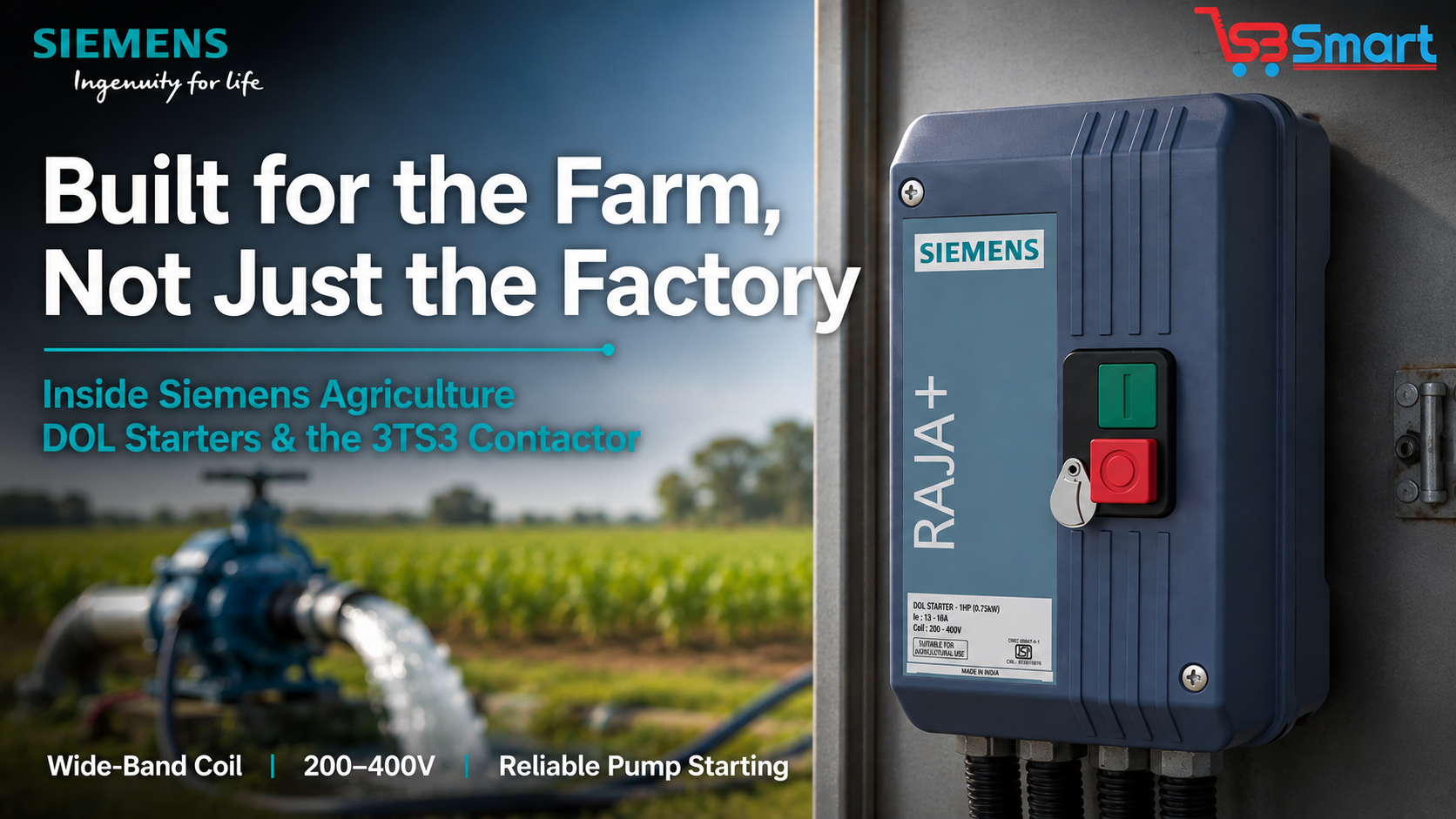
Built for the Farm, Not Just the Factory: Inside Siemens' Agriculture DOL Starters and the 3TS3 Contactor
Ask any farmer running an irrigation pump set in a rural feeder area about their biggest electrical headache, and voltage fluctuation almost always comes up before anything else. Rural power supply rarely holds a steady 415V the way an urban industrial connection might - it sags, it spikes, and it does both unpredictably depending on the season, the time of day, and how many other pumps are drawing load on the same line at once. Most standard motor starters simply were not designed with this reality in mind. Siemens' agriculture-specific DOL starter range was.
A Starter Built Around a Different Set of Problems
Direct-On-Line (DOL) starters are nothing new - they're the simplest, most widely used way to start a motor directly at full voltage, and for pump sets up to 10 HP, they remain the practical choice across Indian agriculture. What sets Siemens' agriculture DOL starter apart isn't the basic starting principle, but the component sitting at its core: the 3TS3 contactor, engineered specifically with the demands of both industrial and agricultural use in mind. Siemens didn't simply repurpose a standard industrial contactor for farm use and call it done. The 3TS3 was developed with the specific operating conditions of agricultural pump applications factored into the design from the start, which shows up most clearly in one particular feature: its coil.
The Wide-Band Coil: Small Detail, Big Practical Difference
A standard contactor coil is built to operate reliably within a fairly tight voltage window around its rated value - step too far outside that range, and the coil either fails to hold the contactor in, or it runs hot and wears out prematurely. In a rural agricultural feeder where voltage can swing considerably through the day, this narrow tolerance becomes a genuine operational problem, leading to nuisance drop-outs, repeated restarts, and shortened component life. Siemens addressed this directly by designing a special wide-band coil for the 3TS3 contactor, rated to operate reliably across a 200-400V range. Rather than needing tight voltage regulation to function correctly, the contactor is built to simply keep working through exactly the kind of fluctuation that rural supply lines are known for. For a farmer who cannot control what voltage the local feeder delivers on any given day, this is a genuinely practical piece of engineering rather than a marketing spec.
Why This Matters for Pump Set Reliability
An irrigation pump that won't start reliably, or one that trips repeatedly during a critical watering window, isn't just an inconvenience - it can directly affect crop outcomes for the season. Every unnecessary contactor drop-out and restart cycle also adds mechanical wear, shortening the working life of the starter and increasing the chances of a breakdown at the worst possible time, typically right when the pump is needed most. By building the 3TS3 contactor to tolerate a wide voltage band without dropping out, Siemens' agriculture DOL starters directly target this failure mode. The result is a starter that keeps the motor running through voltage conditions that would cause a standard-coil contactor to chatter, drop out, or fail outright - translating into fewer nuisance stoppages and a longer service life for the starter as a whole.
Enhanced Electrical and Mechanical Life
Beyond voltage tolerance, moving to 3TS series contactors gives these starters a meaningful step up in both electrical and mechanical durability compared to older contactor designs. In practical terms, this means the contactor can handle more switching operations over its working life before contact wear or mechanical fatigue becomes a concern - a genuinely important factor for pump sets that may be switched on and off multiple times a day during peak irrigation season. For a component that sits at the heart of every motor start, this durability improvement compounds over years of use, reducing how often a starter needs replacement or repair and cutting down on the kind of unplanned downtime that's hardest to deal with in the middle of a farming season.
Frequently Asked Questions (FAQs)
1. What is a Direct-On-Line (DOL) starter, and why is it preferred for agricultural pumps?
Answer: A Direct-On-Line (DOL) starter connects an electric motor directly to full supply voltage without any initial voltage reduction. For pump sets up to 10 HP, it is the simplest, most reliable, and cost-effective starting method, making it the standard choice for agricultural applications across India.
2. How does the Siemens 3TS3 contactor differ from a standard industrial contactor?
Answer: Siemens specifically engineered the 3TS3 contactor to handle harsh rural power conditions. Its standout feature is a wide-band coil (200–400V), which allows the contactor to remain reliably latched during severe voltage sags and spikes—preventing frequent nuisance drop-outs common in standard industrial contactors.
3. Why is voltage fluctuation a major issue for agricultural pump starters?
Answer: Rural power lines frequently experience severe voltage sags and spikes due to fluctuating loads. Standard contactor coils operate within a narrow voltage range; when supply strays outside this limit, the contactor chatters, trips repeatedly, or overheats, leading to motor downtime and coil burnout.
4. What operating voltage range can the 3TS3 wide-band coil handle?
Answer: The wide-band coil of the Siemens 3TS3 contactor is designed to operate seamlessly across a 200V to 400V range. This wide window ensures continuous pump operation without requiring external voltage stabilizers.
5. Does using a 3TS series contactor extend the overall life of the starter?
Answer: Yes. The 3TS series features enhanced electrical and mechanical endurance designed to withstand frequent ON/OFF switching cycles during peak irrigation seasons. By reducing contact wear and eliminating constant tripping, it significantly extends the service life of both the starter and the pump set.
Where These Starters Fit
Agricultural Pump Sets up to 10 HP - The primary application, covering the vast majority of irrigation pump installations across Indian farms running on single or three-phase rural supply.
Rural Feeder Connections with Known Voltage Instability - Areas where supply voltage regularly drifts outside the standard tolerance band, making the wide-band coil design genuinely relevant rather than a nice-to-have.
Industrial Applications with Similar Voltage Challenges - Since the 3TS3 was designed considering both industrial and agricultural requirements, similar benefits carry over to industrial motor applications facing comparable supply fluctuation.
What This Means When You're Choosing a Starter
For anyone specifying a motor starter for a pump set - whether it's a new installation or a replacement for a starter that's been failing repeatedly - the practical takeaway is straightforward: a starter is only as reliable as its weakest component under real operating conditions, and for agricultural applications, that weak point has historically been the contactor coil's tolerance to voltage swings. Choosing a starter built around the 3TS3 contactor addresses that specific failure point directly, rather than leaving it to chance. Genuine Siemens agriculture DOL starters with the 3TS3 contactor are available at SB Smart. If you have a specific pump set rating or an existing starter you're looking to replace, sharing those details is the fastest way to confirm the right configuration for your setup.
The Bottom Line
Agriculture doesn't run on the same clean, stable power supply that a factory floor typically enjoys, and equipment designed without that reality in mind tends to fail exactly where farmers can least afford it. Siemens' agriculture DOL starters, built around the 3TS3 contactor and its wide-band 200-400V coil, are a direct response to that gap - engineering that trades a bit of specification complexity for something farmers actually need: a starter that keeps working, season after season, regardless of what the local feeder decides to do on any given day.