
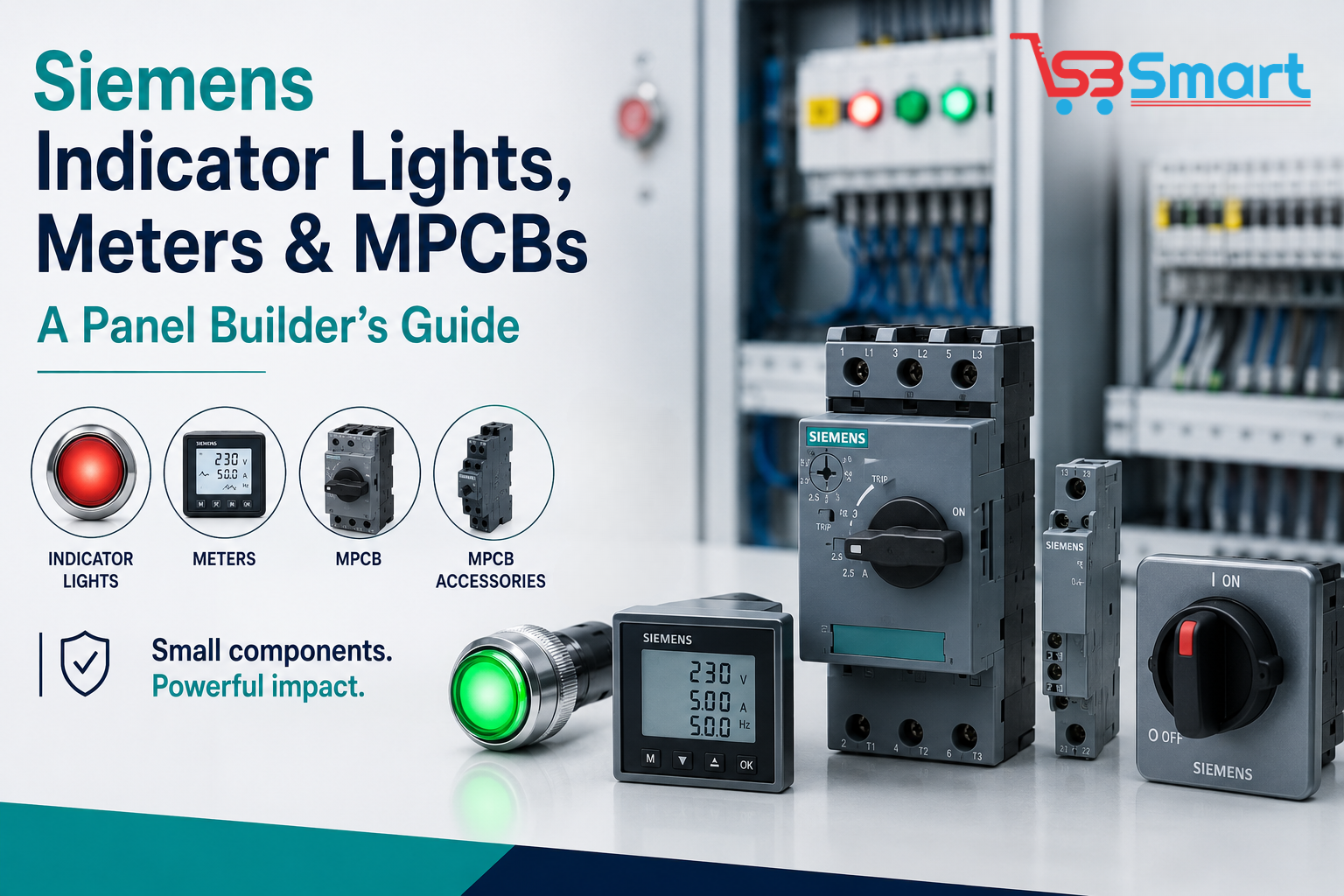
If you've ever stood in front of an industrial control panel and wondered why it "just works" — day after day, without nuisance trips or mystery failures — chances are a handful of unglamorous components are doing the heavy lifting behind the scenes. Not the flashy PLCs or the drives everyone talks about. I'm talking about the quiet workhorses: indicator lights, meters, and motor protection circuit breakers.
At SB Smart, we spend a lot of our time around panel builders and maintenance engineers, and one thing has become clear: these components rarely get the credit they deserve — until something goes wrong. So let's give them their due. Here's a practical, no-nonsense look at five Siemens products that quietly keep your electrical systems safe, visible, and running smoothly.
1. Metal Indicator Light — Small Signal, Big Responsibility
Picture a control panel with no indicator lights. No red glow to tell you a fault has occurred. No green light confirming the motor is running. Just a blank metal face and a lot of guesswork. That's the world indicator lights save us from.
Siemens' metal indicator lights are built for exactly the kind of environments where plastic housings give up early — heavy vibration, dust, moisture, and the general wear and tear of industrial life. The metal body isn't just about looking rugged; it genuinely holds up better over years of continuous duty, which matters when a panel is expected to run reliably for a decade or more.
What I appreciate about these is the simplicity of the idea paired with the seriousness of the execution. A well-placed, clearly visible indicator light can be the difference between an operator catching a problem in seconds versus a technician tracing a fault for an hour. It's a tiny component with an outsized impact on situational awareness.
2. Meters — Because You Can't Manage What You Don't Measure
Every experienced electrical engineer has a version of the same story: a system that "felt fine" until the meter readings told a completely different truth. Voltage fluctuations, current imbalances, power factor drift — these things don't always announce themselves with sparks and smoke. Often, they show up first as numbers on a display.
Siemens meters are designed to give panel operators and facility managers that early visibility — real-time voltage, current, power, and energy consumption data that turns guesswork into informed decisions. Whether it's a simple analog panel meter or a more advanced digital multifunction meter feeding data into a monitoring system, the underlying job is the same: tell the truth about what's happening in the circuit, continuously and accurately.
In an era where energy costs and efficiency matter more than ever, a good meter isn't a luxury add-on. It's how you catch waste before it becomes a line item you regret.
3. MPCB — The Unsung Guardian of Your Motors
Now for the star of the show: the Motor Protection Circuit Breaker, or MPCB.
If indicator lights tell you what's happening and meters tell you how much, the MPCB is the one that actually steps in and does something about it. Its entire purpose is to protect motors — arguably the most expensive and most failure-prone assets in most industrial setups — from the two things that kill them fastest: overload and short circuit.
Siemens MPCB are engineered to strike a genuinely difficult balance. They need to be sensitive enough to catch a real overload condition before windings start cooking, but tolerant enough not to trip on the normal inrush current every motor draws at startup. Nuisance tripping is more than an annoyance — it's downtime, it's frustrated operators, and eventually, it's people bypassing safety features out of sheer irritation. A well-calibrated MPCB avoids that trap entirely.
Beyond the basic protection function, these breakers typically offer adjustable current settings so they can be dialed in to match the exact motor they're protecting, rather than using a one-size-fits-all approach. That precision is what separates a motor that lasts fifteen years from one that limps along, degrading a little more with every near-miss overload it wasn't properly shielded from.
4. MPCB Accessories — The Details That Complete the Picture
An MPCB on its own is powerful, but it's the MPCB accessories that turn it into a fully integrated part of your control system. This is the category people tend to overlook — until they need one and don't have it on hand.
We're talking about auxiliary contacts that feed status signals back to a PLC or SCADA system, shunt trips that allow remote de-energization, rotary handles and door-coupling mechanisms that let operators safely switch a breaker from outside a closed panel, and terminal or busbar adapters that make wiring cleaner and faster during installation.
None of these accessories are exciting on their own. But together, they're what allows an MPCB to communicate, integrate, and operate safely within a larger automated system rather than functioning as an isolated component. Good panel design is really an exercise in getting a hundred small details right, and MPCB accessories are a big part of that equation.
5. MPCBs — Scaling Protection Across the Whole System
It's worth zooming out for a moment. When we talk about "MPCBs" as a broader category rather than a single unit, we're really talking about a protection strategy that spans an entire facility — every motor branch circuit, every pump, every conveyor, every fan, each with its own dedicated, correctly rated breaker standing guard.
This is where Siemens' range genuinely shows its depth. Different motor sizes, different starting characteristics, different panel layouts — there's rarely a single "right" MPCB for every application, which is exactly why having a broad, well-engineered range matters. The goal isn't just protecting one motor well; it's building a consistent, reliable protection philosophy across dozens or hundreds of them, so that maintenance teams aren't relearning a new breaker's quirks every time they open a different panel.
Bringing It All Together
None of these five components work in isolation. The indicator light tells the story. The meter provides the evidence. The MPCB takes action when something goes wrong. The accessories connect that action to the rest of the system. And the broader MPCB range ensures that protection philosophy scales consistently across an entire facility.
It's easy to get caught up in the more glamorous parts of industrial automation — the software, the connectivity, the dashboards. But reliability is almost always won or lost at this level: solid components, correctly specified, quietly doing their jobs day after day. Siemens has built a genuinely strong reputation in this space for a reason, and honestly, once you've dealt with the alternative — panels with vague indication, no real-time data, and motors dying from silent overloads — you start to appreciate just how much these "boring" components are actually doing for you.
So next time you're specifying a panel, don't treat indicator lights, meters, MPCBs, and their accessories as an afterthought. Treat them as what they really are: the foundation everything else depends on.
Explore the full range at sbsmart.in.