
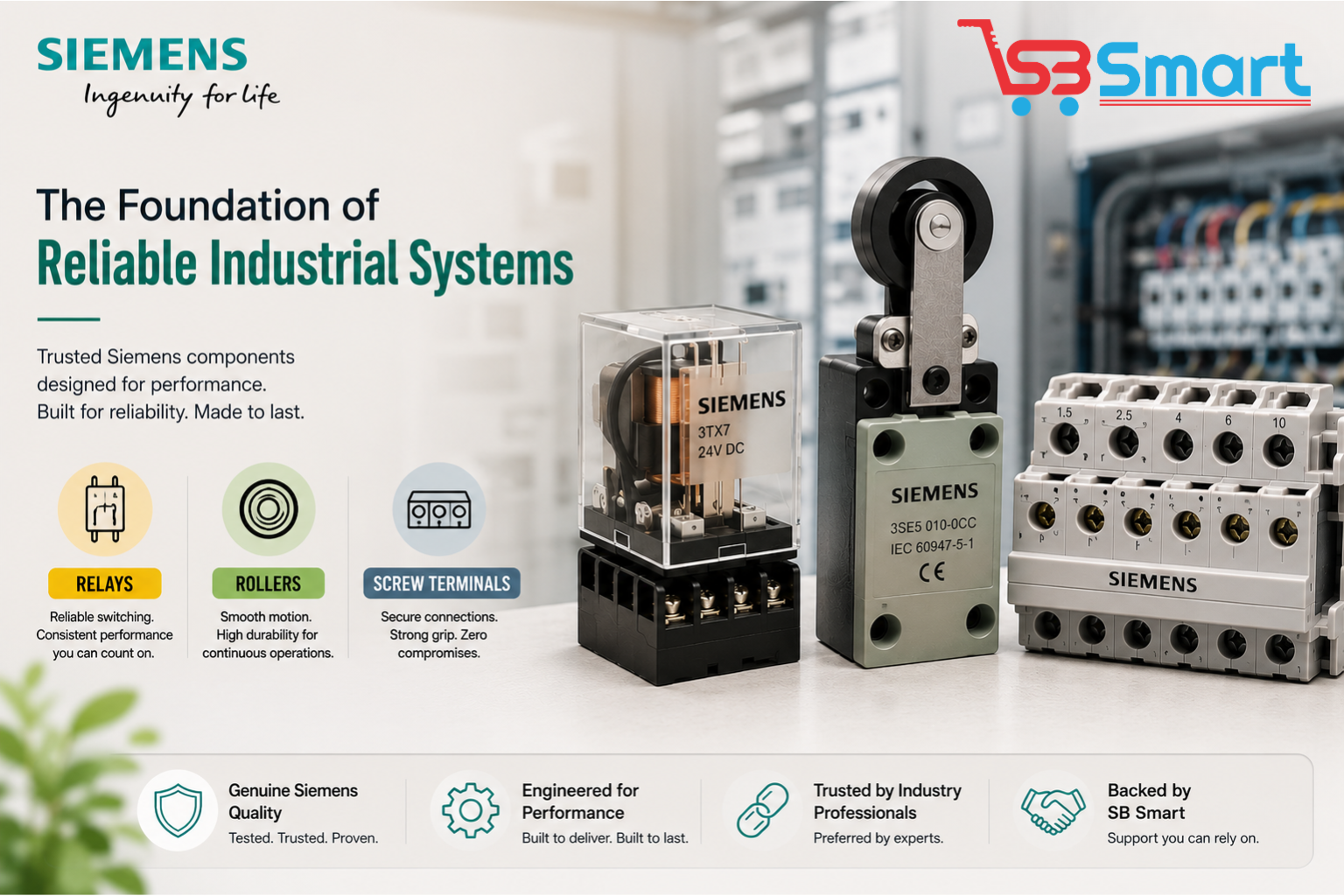
Walk into any control panel room, and you won't see much drama. No flashing lights, no dramatic music — just rows of neatly wired components quietly doing the hardest job in the building: keeping everything running. And more often than not, if you look closely, you'll spot the Siemens name stamped on the parts doing the heavy lifting.
At SB Smart, we've spent years sourcing and supplying industrial components to engineers, panel builders, and maintenance teams who don't have the luxury of "it usually works." They need components that always work. That's exactly why Siemens Relays, Rollers, and Screw Terminals are among our most trusted, most requested products — and today, we're breaking down why they deserve a spot in your next project too.
Industrial buyers don't always get excited about components like these. They're not the parts you show off in a product demo. But talk to any experienced maintenance engineer, and they'll tell you the same thing: the projects that run smoothly are rarely the ones with the flashiest technology. They're the ones where every single component — down to the smallest terminal block — was chosen with care. That's the philosophy SB Smart operates on, and it's the same philosophy that has kept Siemens at the top of the industrial components industry for decades.
In this piece, we'll walk through each of these three components in detail — what they do, why Siemens does it better, and why choosing genuine parts, instead of cutting corners, protects your project in the long run.
The Relay: Small Component, Massive Responsibility
If your control system were a nervous system, relays would be the synapses — tiny switches that decide when signals get passed on and when they don't. Siemens relays are built for exactly this kind of responsibility. They switch loads cleanly, resist wear over thousands of operating cycles, and give engineers the confidence that a critical circuit won't fail at the wrong moment.
What makes Siemens relays stand out isn't just the switching capacity — it's the consistency. Batch after batch, panel after panel, they behave the way the datasheet says they will. In industrial automation, that kind of predictability isn't a nice-to-have. It's the whole game.
At SB Smart, we see this reliability reflected in something simple: customers rarely come back with complaints. They come back for more stock.
Think about how many different jobs a relay quietly handles — isolating control circuits from power circuits, protecting sensitive electronics from voltage spikes, enabling automation logic to make split-second decisions, and allowing low-power signals to control much larger loads safely. A single weak relay in a large panel can create a fault that takes hours to trace. A dependable one just disappears into the background, doing its job without ever becoming the topic of conversation. That invisibility is, ironically, the highest compliment you can pay an electrical component — and it's exactly what Siemens relays consistently deliver, whether they're used in manufacturing plants, HVAC systems, power distribution boards, or process automation lines.
The Roller: Motion That Doesn't Miss a Beat
Every automated line, every conveyor system, every mechanism that needs smooth, repeated motion depends on components that won't hesitate under pressure. Siemens rollers are engineered for exactly that kind of demanding, repetitive duty — built to handle constant motion without the wear, noise, or drift that cheaper alternatives develop over time.
For industries running near-continuous operations, a roller that fails mid-shift isn't a minor inconvenience — it's downtime, lost output, and a maintenance team scrambling to fix something that should have just worked. Siemens engineers rollers with that reality in mind, which is exactly why SB Smart keeps them stocked and ready for teams who can't afford to wait.
The real test of a roller isn't day one — it's month twelve, when it's still running true, still gripping evenly, and still holding tolerance after thousands of operating hours. Cheaper alternatives often perform fine early on, only to develop wobble, uneven wear, or noise once they've been through a real production cycle. That's when the true cost of a "budget" component shows up — in lost throughput, unplanned maintenance, and replacement cycles that eat into any money saved upfront. Siemens rollers are built to avoid that trap altogether, which is why teams that switch to them rarely switch back.
The Screw Terminal: The Handshake Every Circuit Depends On
Here's an underrated truth about electrical systems: most failures don't happen in the fancy components. They happen in the connections. A loose terminal, a weak grip, a contact point that degrades under vibration — that's where things quietly go wrong.
Siemens screw terminals solve this at the most fundamental level. They deliver a firm, lasting grip on wiring, resist loosening from vibration, and make sure that every connection stays exactly as solid as the day it was installed. It's not glamorous engineering, but it's the kind that prevents 3 a.m. emergency call-outs.
When SB Smart's clients ask us what "reliable wiring" actually looks like in practice, our answer is simple: it looks like a Siemens screw terminal doing its job silently for years.
There's a reason experienced panel builders pay close attention to terminal quality even when everything else in the design is already decided. A terminal isn't just a mechanical clamp — it's the point where design meets reality, where a schematic diagram becomes an actual working current path. If that connection is even slightly inconsistent, it can create resistance, heat, and eventually failure, often in the hardest place to diagnose. Siemens screw terminals are built with tight manufacturing tolerances and durable materials specifically to eliminate that risk, giving engineers one less variable to worry about when everything else in a project is already complex enough.
Where These Components Actually Get Used
It's easy to talk about relays, rollers, and screw terminals in the abstract — but the real story is in where they end up. Across the projects SB Smart supports, these three components consistently show up in:
Manufacturing plants, where automated production lines depend on relays for control logic and rollers for material handling.
Power distribution and switchgear panels, where screw terminals hold together the wiring that keeps facilities powered safely.
HVAC and building automation systems, where relays manage the constant switching between heating, cooling, and ventilation loads.
Conveyor and packaging lines, where rollers are in near-constant motion, day after day, shift after shift.
Process industries, including chemical, food, and water treatment plants, where a single failed connection can mean a full production stop.
Different industries, different demands — but the same underlying requirement: components that don't quit halfway through the job.
The Real Cost of Choosing Cheaper Alternatives
There's always a temptation in procurement to go with whatever costs less upfront. And on paper, unbranded or imitation components can look like an easy win. But engineers who've been in the field long enough know how this story usually ends — a slightly lower purchase price followed by a much higher cost in downtime, troubleshooting, and premature replacement.
Genuine Siemens components go through rigorous manufacturing standards and quality testing that budget alternatives simply don't match. That's not a marketing line — it's the difference between a relay that switches cleanly for years and one that starts sticking after a few thousand cycles. It's the difference between a roller that runs true and one that starts vibrating after a few months. It's the difference between a terminal that holds firm and one that quietly loosens until it causes a fault nobody saw coming.
This is exactly why SB Smart only deals in genuine Siemens products. We'd rather our clients pay for quality once than pay for failure repeatedly.
Why SB Smart Chooses to Champion These Products
We don't just sell components — we stand behind them. Every Relay, Roller, and Screw Terminal that leaves our warehouse carries the same promise we've built our name on: genuine Siemens quality, backed by a supplier who actually understands what engineers need.
That's the SB Smart difference. We're not just a supply chain link — we're a partner who knows that behind every order is a project that has to work the first time, every time.
The Bottom Line
Great automation isn't built on the flashiest parts — it's built on the parts that never let you down. Siemens Relays, Rollers, and Screw Terminals have earned their reputation the old-fashioned way: by simply performing, project after project, year after year.
And when you're ready to build with components you can actually trust, SB Smart is here — stocked, ready, and standing behind every part we deliver.
Looking to source genuine Siemens Relays, Rollers, or Screw Terminals for your next project? Get in touch with the SB Smart team today.