
If you've ever stood in front of a motor control panel trying to figure out why a motor tripped — again — you know the frustration. Was it an overload? A phase failure? Did someone forget to check the ground fault settings? In the old days, you'd need a multimeter, a healthy dose of patience, and probably a call to the electrician who wired the thing five years ago.
That's exactly the headache Siemens set out to solve with SIMOCODE Pro, and honestly, once you've worked with it, it's hard to go back to conventional motor protection relays.
So, What Exactly is SIMOCODE Pro?
At its core, SIMOCODE Pro is a modular motor management system. Instead of using a bunch of separate devices to protect, control, and monitor a motor, SIMOCODE Pro brings everything into one intelligent system. It handles overload protection, short-circuit monitoring, ground fault detection, and motor control — all while feeding real-time diagnostic data back to your control system.
What really sets it apart is the modularity. You're not locked into a single configuration. You pick a basic unit, and then build out exactly what you need with expansion modules — whether that's additional digital inputs, analog measurement, or communication modules for protocols like PROFIBUS or PROFINET.
This isn't just protection anymore, it's genuine visibility into what's happening at the motor level, in real time, without needing a technician to physically walk the plant floor every time something feels off.
The Accessories That Make It Click (Literally)
A system is only as good as the ecosystem around it, and this is where SIMOCODE Pro accessories quietly do a lot of heavy lifting.
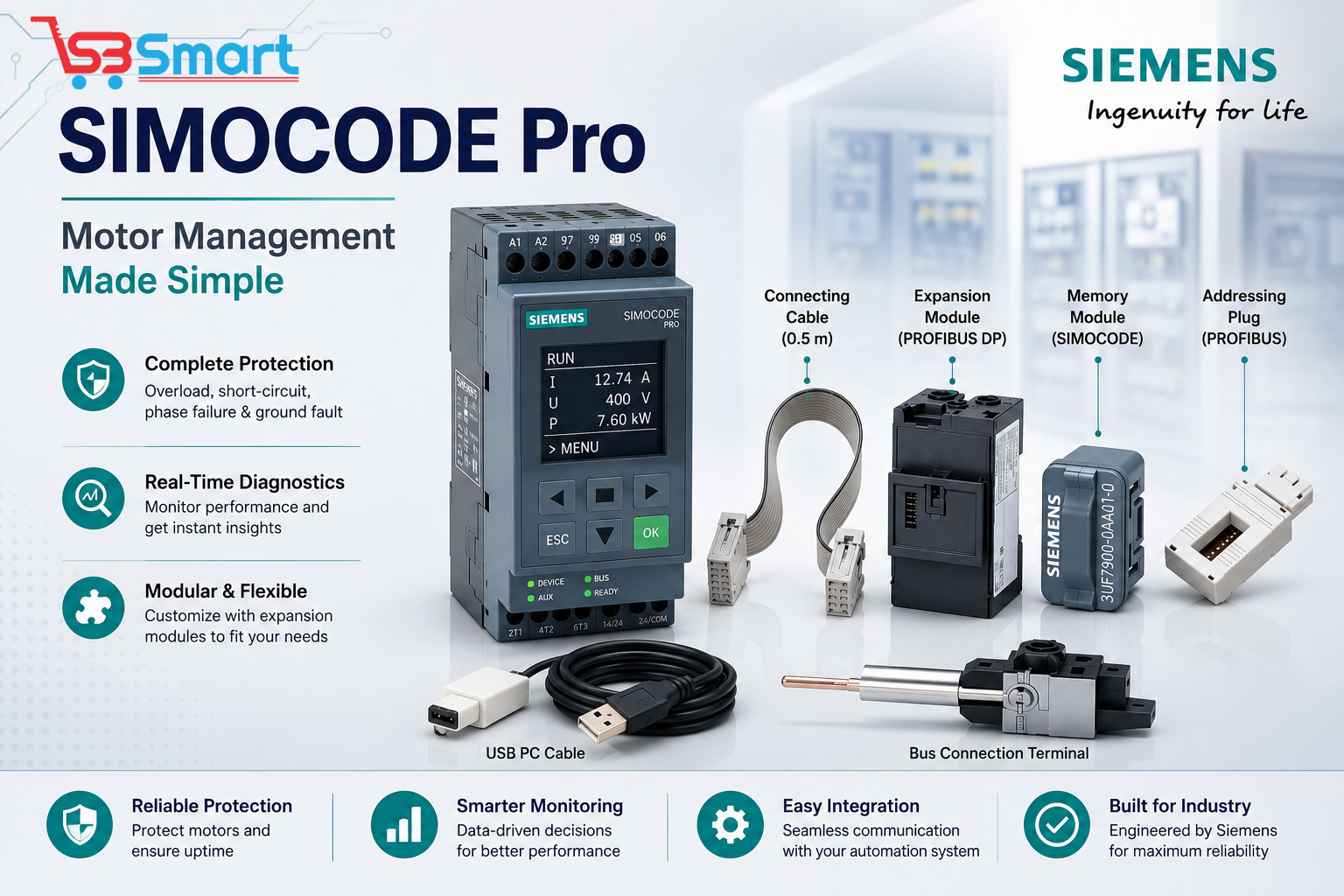
Connecting cables — these small, round cables might look unremarkable, but they're what physically link your basic unit to expansion modules. Get the length wrong or use a cheap substitute, and you'll be chasing communication faults for days. Siemens offers these in standard lengths (like the 0.5 m variant) specifically engineered for reliable, low-noise connections between modules.
Expansion modules — this is where things get interesting. A PROFIBUS DP plug-in expansion module, for instance, lets your SIMOCODE Pro system talk directly to your plant's fieldbus network. Suddenly your motor management system isn't an isolated island — it's part of a fully integrated automation architecture, feeding data straight into your SCADA or DCS.
And when you pair SIMOCODE Pro with power monitoring devices like the SENTRON PAC3120, you get an even fuller picture — voltage, current, and power quality data sitting right alongside your motor diagnostics. For anyone managing energy costs or trying to get ahead of equipment degradation, that combination is gold.
A Quick Trip Down Memory Lane: Life Before SIMOCODE Pro
Anyone who's worked in industrial automation for more than a decade remembers the old way of doing things. Motor protection used to mean a thermal overload relay bolted next to a contactor, a separate ground fault relay if you were lucky enough to have one specified, and maybe a standalone ammeter if someone wanted to keep an eye on load. None of these devices talked to each other. None of them talked to your control system either, unless you wired in a mess of auxiliary contacts and hoped nothing degraded over time.
Troubleshooting meant walking the panel, pulling covers, and physically checking indicator lights or flipped flags on relays. If a motor tripped at 2 a.m., someone was getting a phone call, and that someone was driving to the plant.
SIMOCODE Pro didn't just digitize this process — it fundamentally rethought it. By consolidating protection, control, and communication into a single modular platform, Siemens essentially collapsed what used to be five or six separate devices into one coherent system that speaks the same language as the rest of your automation architecture.
Breaking Down the Basic Unit
The heart of any SIMOCODE Pro setup is the basic unit, and Siemens offers a few variants depending on how much intelligence and connectivity you actually need.
- SIMOCODE Pro V — the full-featured version, offering advanced motor management including comprehensive protection functions, extensive diagnostics, and support for a wide range of expansion modules.
- SIMOCODE Pro S — a step down in complexity for standard motor management applications, still delivering solid protection without all the bells and whistles.
- SIMOCODE Pro C — a compact option for space-constrained panels or smaller installations that don't need the full diagnostic suite.
Choosing the right basic unit really comes down to what you're protecting and how much data you want back. A simple conveyor motor might not need the same level of granularity as a critical process pump feeding a reactor. This is honestly one of the most underrated aspects of the system — it scales down as gracefully as it scales up, so you're not paying for intelligence you don't need.
Digging Deeper Into the Accessory Lineup
We touched on connecting cables and expansion modules earlier, but it's worth slowing down and looking at just how much thought Siemens put into the accessory ecosystem, because this is often where projects succeed or stumble.
Connecting cables aren't just simple ribbon cables — they're precision components rated for the specific communication protocol running between the basic unit and its modules. The round, flexible design isn't just for aesthetics either; it's built to survive the vibration and thermal cycling that panels experience over years of operation. A 0.5 m cable is a common choice for tightly packed enclosures, though longer variants exist for panels with more breathing room.
Expansion modules come in a surprising variety:
- Digital I/O modules for handling additional field signals
- Analog modules for temperature sensors (like PT100/PT1000 RTDs) — crucial for motors where thermal monitoring matters as much as current monitoring
- Ground fault modules for sensitive earth leakage detection
- Communication modules supporting PROFIBUS DP, PROFINET, and other industrial protocols
Current transformers and measuring modules round out the picture, letting SIMOCODE Pro accurately measure current draw across a wide range of motor sizes without needing oversized, clunky hardware.
But the accessory list goes further than most people expect, and a few of these smaller components genuinely deserve more attention than they get:
- Flat connecting cables (0.025 m) — for basic units and modules mounted right next to each other, these short, flat cables keep connections tidy inside tightly packed enclosures where a longer round cable would just create unnecessary clutter.
- Memory modules for parameterization — this is one of those accessories that quietly saves hours of commissioning time. Instead of manually re-entering every protection parameter on a replacement unit, a memory module lets you store and transfer the full configuration in seconds. Swap a faulty basic unit, plug in the memory module, and you're back up and running without re-programming from scratch.
- Addressing plugs for PROFIBUS — assigning bus addresses manually across dozens of motor starters can be tedious and error-prone. Addressing plugs simplify this by letting each SIMOCODE Pro unit be assigned its address mechanically, cutting down on configuration mistakes during commissioning.
- USB PC cables — for direct connection to a laptop running the SIMOCODE ES parameterization software, letting engineers configure, test, and troubleshoot units directly from a PC without needing a full fieldbus connection just to get started.
- Bus connection terminals — these handle the physical tap-off from the main PROFIBUS trunk line to each SIMOCODE Pro unit, and getting this connection right is often what separates a stable bus network from one that throws intermittent faults months down the line.
Individually, none of these accessories look particularly exciting sitting on a shelf. But put them together in a real commissioning scenario — a panel builder trying to get twenty motor starters online and talking to a PLC by the end of the week — and you start to see how much time and frustration they save.
And when you bring in something like the SENTRON PAC3120 power monitor, you're no longer just protecting the motor — you're capturing power quality data: voltage imbalance, harmonics, power factor, energy consumption trends. For facilities chasing energy efficiency certifications or simply trying to control utility costs, this kind of layered monitoring pays for itself surprisingly fast.
Why This Actually Matters on the Floor
Here's the practical bit. Downtime is expensive, and unplanned downtime is worse. A motor that trips without warning can halt an entire production line. SIMOCODE Pro's real value isn't just in protecting the motor — it's in giving you the diagnostic breadcrumbs before a failure becomes catastrophic. Rising current trends, temperature drift, insulation degradation — you can catch these early instead of reactively.
For panel builders and system integrators, the modular accessory ecosystem also means less inventory headache. You're not stocking ten different relay types for ten different motor sizes. You standardize on SIMOCODE Pro and just configure accessories per application.
Where You'll Actually Find SIMOCODE Pro at Work
It's easy to talk about specs in the abstract, but SIMOCODE Pro earns its keep in some pretty demanding environments:
- Water and wastewater treatment plants, where pump motors run continuously and unplanned downtime means real regulatory and environmental consequences.
- Food and beverage processing, where hygiene requirements and tight production schedules leave little room for guesswork on motor health.
- Oil, gas, and petrochemical facilities, where ground fault detection and rigorous protection aren't optional — they're safety-critical.
- Cement and heavy material handling, where motors are pushed hard and thermal stress is a constant concern.
- Automotive manufacturing lines, where a single stalled conveyor motor can ripple downtime across an entire assembly line.
Across all of these, the common thread is the same: production environments where a motor failure isn't just an inconvenience, it's a cascading problem. SIMOCODE Pro's real strength is catching the early warning signs long before a full stop becomes necessary.
A Few Practical Tips for Anyone Installing It
If you're speccing out a panel with SIMOCODE Pro for the first time, a few lessons learned from the field are worth keeping in mind:
- Don't skimp on cable quality. Genuine Siemens connecting cables are engineered for the exact signal integrity the system needs. A generic substitute might work for a week and then start throwing intermittent communication errors that are maddening to diagnose.
- Plan your expansion modules before you wire the panel. Retrofitting an analog or communication module after the fact is far more painful than designing it in from day one.
- Take advantage of the diagnostic data. Too many installations use SIMOCODE Pro purely as a protection device and never tap into the rich diagnostic data it's capable of feeding back. That's leaving value on the table.
- Match the basic unit to the application, not the budget. It's tempting to standardize on the cheapest variant across a whole plant, but a critical process motor deserves the extra visibility a higher-tier unit provides.
Sourcing It Right
Genuine Siemens components matter more than people realize — especially with something as safety-critical as motor protection. Mismatched or non-genuine cables and modules can cause communication instability or, worse, protection failures you won't notice until it's too late.
This is where working with a trusted industrial automation supplier makes a real difference. SB Smart has built a reputation for sourcing authentic Siemens SIMOCODE Pro systems and accessories, making it easier for engineers and panel builders to get the exact components they need — genuine cables, expansion modules, and monitoring devices — without the guesswork or long lead-time surprises that come with unreliable vendors.
The Takeaway
SIMOCODE Pro isn't flashy. It won't win any design awards. But for anyone who's dealt with the chaos of a poorly protected motor circuit, it represents something better: predictability. Fewer surprise trips, better diagnostics, and a system that scales with your plant instead of against it.
If you're building or upgrading a motor control panel, it's worth taking a serious look at how SIMOCODE Pro — and the right accessories — could simplify your setup and give you visibility you didn't know you were missing.