
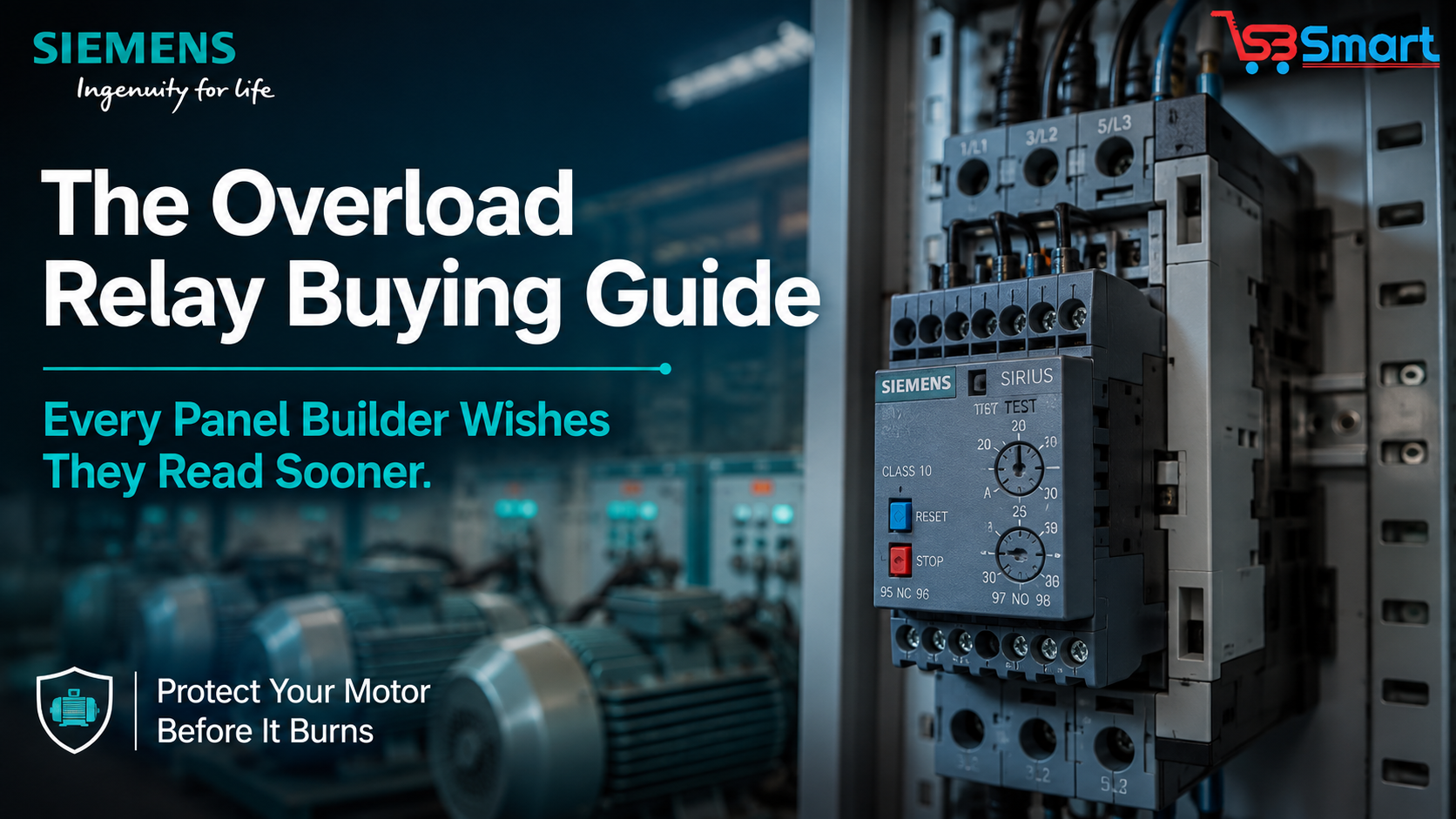
The Overload Relay Buying Guide Every Panel Builder Wishes They Read Sooner
Motors don't usually fail out of nowhere. They fail because something upstream let them run hot, run overloaded, or run stalled for far too long. That "something" is supposed to be your overload relay — and if you buy the wrong one, or skip proper sizing altogether, you're basically letting your motor gamble with its own life.
This guide walks you through everything you need to know before buying an overload relay, so your next purchase actually protects your equipment instead of just sitting in the panel looking official.
What an Overload Relay Actually Does
An overload relay monitors current draw on a motor circuit and trips the connected contactor when current exceeds a safe threshold for too long. It's the difference between a motor tripping safely and a motor's windings turning into expensive smoke.
Unlike a fuse or circuit breaker, which protects against short circuits and massive current spikes, an overload relay protects against sustained, moderate overcurrent — the kind caused by mechanical jams, phase loss, voltage imbalance, or a motor simply working harder than it should.
Step 1: Know Your Motor's Full Load Current (FLA)
Every selection starts here. Check the motor nameplate for FLA at your actual supply voltage. This number is your baseline for setting the relay's trip range — not the horsepower or kW rating alone.
Step 2: Choose Between Thermal and Electronic Overload Relays
- Thermal (bimetallic) overload relays — Simple, reliable, cost-effective, and ideal for standard motor protection where budget matters. Adjustable dial covers a current range, and they trip based on heat buildup mimicking motor winding temperature.
- Electronic overload relays — Offer more precise protection, phase-loss detection, adjustable trip classes (10, 20, 30), communication options (for PLC/SCADA integration), and better repeatability. Worth the extra cost for critical motors or where downtime is expensive.
Step 3: Match the Trip Class to Your Application
Trip class defines how long the relay allows overload conditions before tripping:
- Class 10 — Fast trip, ideal for light-duty or quick-starting motors
- Class 20 — Standard for most general industrial motors
- Class 30 — For high-inertia loads with longer start times (large pumps, fans, compressors)
Choosing the wrong class either trips your motor too soon during normal startup or lets it cook for too long during an actual fault.
Step 4: Confirm Compatibility with Your Contactor
This is where a lot of buyers slip up — not every overload relay mounts directly onto every contactor. Check mechanical mounting compatibility and current range alignment with the contactor you're pairing it with. Mismatched combinations can void coordination ratings (Type 1/Type 2) required for compliant panels.
Step 5: Check for Phase Loss and Imbalance Protection
Single-phasing is one of the most common (and most damaging) motor failures in three-phase systems. A good overload relay should detect phase loss and imbalance quickly, especially in electronic models — this alone can save a motor that would otherwise burn out silently.
Step 6: Think About Reset Type
- Manual reset — Requires physical intervention before restart; safer for applications where an unattended automatic restart could be hazardous.
- Automatic reset — Convenient for unmanned or remote equipment, but only appropriate where an unexpected restart won't cause safety issues.
Why Brand Choice Matters — And Why We Recommend Siemens
Not all overload relays are built to the same standard, and this is one component where cutting corners rarely pays off. Between the major options in the market, Siemens overload relays consistently stand out for their trip-curve accuracy, build quality, long-term reliability, and seamless compatibility with SIRIUS contactor lines. If you're building a panel meant to last, pairing a Siemens contactor with a Siemens overload relay keeps your coordination ratings clean and your maintenance calls rare.
If you're sourcing components for your panel, SBSmart is a solid place to check stock and pricing on genuine Siemens overload relays and contactors — worth adding to your supplier shortlist before you finalize your BOM.
Quick Buying Checklist
- Motor FLA confirmed from nameplate
- Thermal vs. electronic decision made based on application criticality
- Correct trip class selected (10 / 20 / 30)
- Mechanical and current-range compatibility with contactor verified
- Phase-loss/imbalance protection confirmed
- Reset type suits the application's safety needs
- Genuine Siemens overload relay sourced from a trusted supplier like SBSmart
Frequently Asked Questions (FAQ)
1. What is an overload relay used for? An overload relay protects a motor from sustained overcurrent caused by mechanical jams, phase loss, or excessive load, tripping the connected contactor before the motor windings overheat and burn out.
2. What is the difference between a thermal overload relay and an electronic overload relay? A thermal overload relay uses a bimetallic strip that trips based on heat buildup, while an electronic overload relay uses current sensing for more precise protection, phase-loss detection, and adjustable trip classes.
3. How do I select the right overload relay for a motor? Check the motor's Full Load Current (FLA) from the nameplate, match it to the relay's current range, choose the correct trip class (10, 20, or 30), and confirm mechanical compatibility with your contactor.
4. What is trip class in an overload relay? Trip class defines how long an overload relay allows an overcurrent condition before tripping. Class 10 trips fastest, Class 20 suits general motors, and Class 30 suits high-inertia loads like large pumps and compressors.
5. Can any overload relay be used with any contactor? No. Overload relays must be mechanically and electrically compatible with the contactor they're paired with to maintain proper Type 1/Type 2 coordination and safe fault protection.
6. Why choose a Siemens overload relay over other brands? Siemens overload relays are known for accurate trip curves, durable build quality, and seamless compatibility with SIRIUS contactors, making them a reliable choice for industrial motor protection.
7. Where can I buy genuine Siemens overload relays? Suppliers like SBSmart stock genuine Siemens overload relays and contactors, making it easier to source verified components for your panel at competitive pricing.
8. What happens if I use the wrong overload relay setting? An incorrectly set overload relay can either trip the motor too often during normal operation or fail to trip in time during a real fault, risking motor damage or fire hazard.
Final Thought
An overload relay is cheap insurance for an expensive motor. Spend the extra few minutes matching it correctly to your load, your contactor, and your application — and lean toward proven brands like Siemens when reliability actually matters. overload relay