
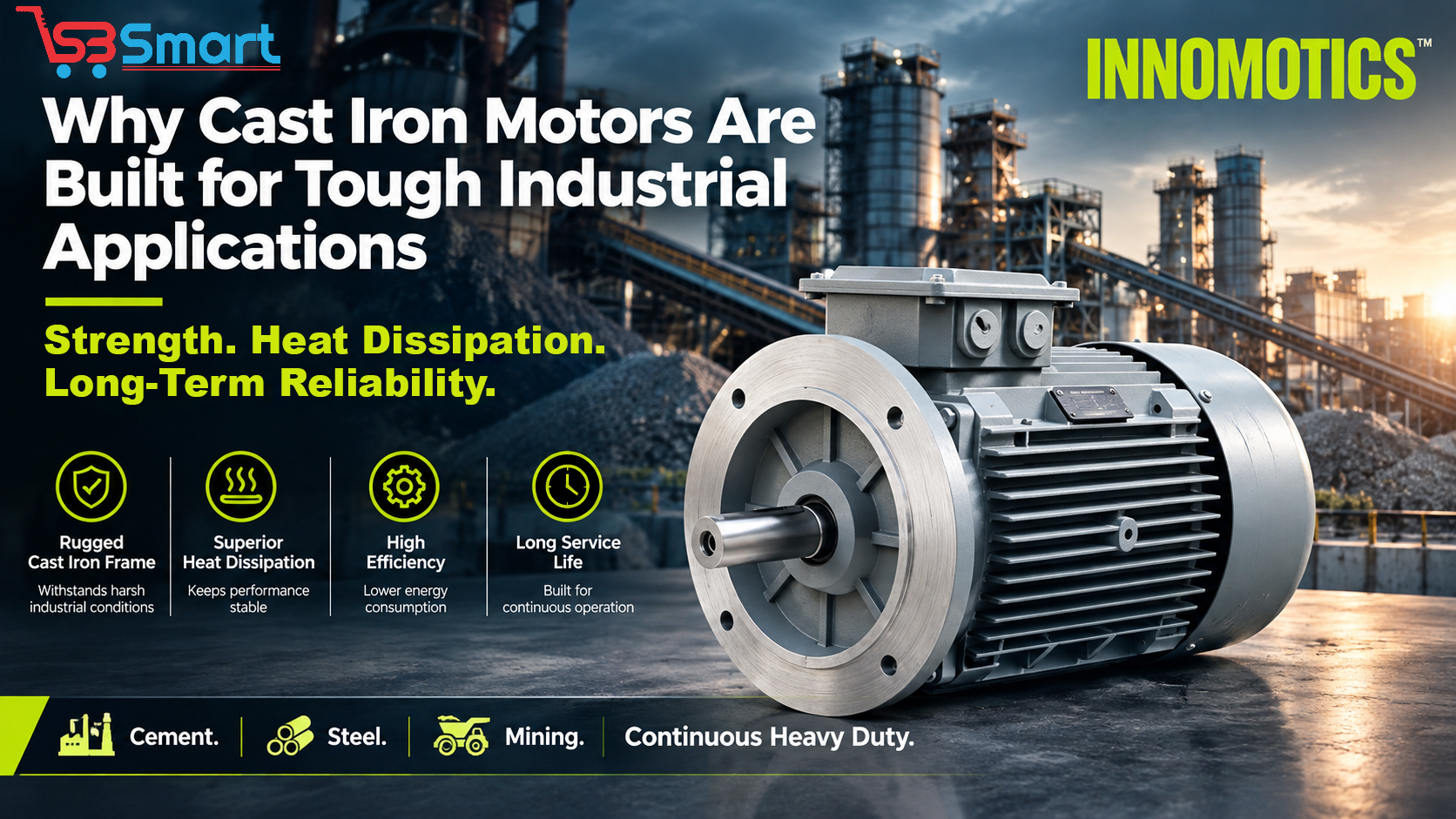
Why Cast Iron Motors Are Built for Tough Industrial Applications
Walk through any heavy industrial plant — a cement unit, a steel mill, a large pump house — and you'll notice the motors driving the critical equipment almost always share one thing: a solid, rugged cast iron body. That's not a coincidence or an aesthetic choice. It's a deliberate engineering decision, made because plastic or aluminum-bodied motors simply can't survive what these environments throw at them day after day.
This guide explains what actually makes cast iron motors different, why that construction matters so much in demanding applications, and walks through three real Innomotics cast iron motor models to show how the range scales across power ratings.
What Makes a Cast Iron Motor Different?
A cast iron motor uses a cast iron housing instead of the lighter aluminum or composite housings found on smaller general-purpose motors. This single design choice cascades into several real-world advantages:
- Superior mechanical strength — cast iron withstands heavy mechanical stress, vibration, and shock loading far better than lighter materials, which matters enormously in applications with constant vibration or heavy start/stop cycling.
- Better heat dissipation under sustained load — cast iron's thermal mass and conductivity help the motor manage heat more effectively during continuous, high-load operation, reducing the risk of thermal stress over long duty cycles.
- Long-term durability in harsh environments — the housing resists the wear, corrosion, and physical damage that dusty, humid, or chemically aggressive industrial environments inflict over years of continuous operation.
- Higher protection ratings — cast iron construction supports robust sealing, typically achieving IP55 protection as standard, keeping dust and moisture out of the internals even in demanding plant conditions.
Combine that housing with Class F insulation and IC411 self-cooling — standard across this motor family — and you get a motor built to run reliably at full load, in a hot, dusty plant, for years without the internals degrading.
Why This Construction Matters So Much for Tough Applications
It's tempting to think of housing material as a minor spec on a datasheet. In practice, it's often the deciding factor in whether a motor survives its application or fails early. Consider what these motors are actually asked to do:
- Continuous heavy-load operation — pumps, compressors, and conveyors that run for extended periods without rest, generating sustained heat that a lighter housing wouldn't dissipate as effectively
- Vibration and mechanical shock — crushers, mills, and reciprocating equipment where a fragile housing would crack or loosen internal components over time
- Dusty, humid, or chemically harsh environments — cement plants, steel mills, chemical processing units, and outdoor installations where IP55 protection genuinely earns its rating rather than just appearing on a spec sheet
- Long operational lifespans — industrial capital equipment is expected to run for a decade or more; a cast iron housing supports that expectation in a way lighter alternatives simply don't
This is exactly why cast iron motors remain the default choice across cement, steel, mining, chemical processing, and heavy manufacturing industries, even when lighter alternatives exist for less demanding applications.
Innomotics Cast Iron Motors — Three Ratings Across the Range
To see how this construction scales across power requirements, here's a look at three specific models from the Innomotics 1LE7 cast iron series:
1. Innomotics Cast Iron Motor — 15 kW / 20 HP, Frame 160L (1LE7501-1DC73-5AA4)
At the smaller end of this range, the 15 kW (20 HP) motor in a frame size 160L is suited to moderate industrial loads — smaller pumps, fans, and conveyor drives where reliable cast iron construction is still needed, but at a more compact frame footprint and power rating than the plant's larger machinery.
Best suited for: smaller pumps, fans, blowers, and general-purpose industrial drives where dependable, rugged construction matters but full plant-scale power isn't required.
2. Innomotics Cast Iron Motor — 200 kW / 270 HP, Frame 315L (1LE7501-3AC83-5AA4)
Stepping up significantly, this 200 kW (270 HP) motor in the larger frame size 315L is built for substantial industrial loads — large pumps, compressors, crushers, and heavy conveyor systems that demand serious continuous power alongside the durability the cast iron housing provides.
Best suited for: large pumps, compressors, and heavy-duty conveyor or crusher drives in plants where both high power output and long-term mechanical reliability are non-negotiable.
3. Innomotics Cast Iron Motor — 225 kW / 300 HP, Frame 315L (1LE7501-3AB73-5AA4)
At the top of this comparison, the 225 kW (300 HP) motor, also in frame size 315L, pushes further into heavy-industrial power territory. Sharing the same frame size as the 200 kW model but delivering more output, it's suited to the most demanding continuous-duty applications where maximum power density within that frame size is the priority.
Best suited for: the heaviest continuous-duty industrial applications — major pump stations, large compressors, and critical process drives where downtime simply isn't an option.
How to Choose the Right Power Rating for Your Application
- Calculate your actual load requirement — don't size a motor based on a rough estimate; use the driven equipment's actual power demand.
- Match frame size to your existing mounting and coupling arrangement, especially if you're replacing an existing motor.
- Leave a reasonable service factor margin rather than sizing right at the calculated minimum, particularly for applications with variable or peak loading.
- Confirm pole count and speed requirements match your driven equipment — cast iron motors in this series are available across multiple pole configurations for different speed needs.
For a broader look at Innomotics motor technologies beyond the standard cast iron range — including synchronous reluctance and permanent magnet options — see our Innomotics Severe Duty Motors guide.
Where Cast Iron Motors Typically Get Used
- Cement and steel plants — continuous heavy-load operation in dusty, high-temperature environments
- Chemical and process industries — reliable operation across demanding, sometimes corrosive conditions
- Water and wastewater treatment — large pumps requiring sustained, dependable power
- Mining and material handling — crushers, conveyors, and mills facing constant vibration and mechanical stress
- General heavy manufacturing — any application where long-term reliability under continuous load matters more than minimizing weight or cost
Why Buy Genuine Innomotics Cast Iron Motors from SB Smart
A motor's housing construction is exactly the kind of specification that's easy to overlook until it's the reason for an unplanned shutdown. SB Smart supplies genuine Innomotics cast iron motors across the full power range, along with compact, crane duty, fire-fighting pump, and flame-proof motor variants, backed by GST invoicing, competitive B2B pricing, and PAN India delivery.
Frequently Asked Questions (FAQ)
1. Why are cast iron motors preferred for industrial applications?
Cast iron motors offer superior mechanical strength, better heat dissipation, and greater durability in harsh environments compared to lighter aluminum or composite-bodied motors, making them well-suited for continuous heavy-load industrial use.
2. What protection rating do cast iron motors typically offer?
Innomotics cast iron motors in the 1LE7 series typically offer IP55 protection as standard, providing strong resistance to dust and moisture ingress.
3. What is the difference between the 200 kW and 225 kW models in frame 315L?
Both share the same frame size, but the 225 kW model delivers higher power output within that frame, suited to more demanding continuous-duty applications than the 200 kW variant.
4. How do I choose the right cast iron motor power rating?
Calculate your driven equipment's actual load requirement, match the frame size to your mounting arrangement, and leave a reasonable safety margin rather than sizing at the exact calculated minimum.
5. What insulation class do these motors use?
Innomotics cast iron motors in this series use Class F insulation, suited to sustained industrial operating temperatures.
6. Are cast iron motors suitable for dusty or humid environments?
Yes, the combination of cast iron housing and IP55 protection makes them well-suited to dusty, humid, and generally harsh industrial environments.
7. Which industries commonly use cast iron motors?
Cast iron motors are widely used in cement, steel, chemical processing, water treatment, mining, and general heavy manufacturing industries.
8. Where can I buy genuine Innomotics cast iron motors in India?
SB Smart supplies genuine Innomotics cast iron motors with GST invoicing, technical support, and PAN India delivery.
Final Thought
A motor's housing material rarely gets the attention it deserves during specification, but it's often the single biggest factor in whether that motor survives years of tough industrial duty or fails well before its expected lifespan. Whether you need the 15 kW model for a smaller drive or step up to the 200 kW or 225 kW options for heavy-duty plant equipment, Innomotics cast iron motors are built specifically for the environments where reliability genuinely can't be compromised.