
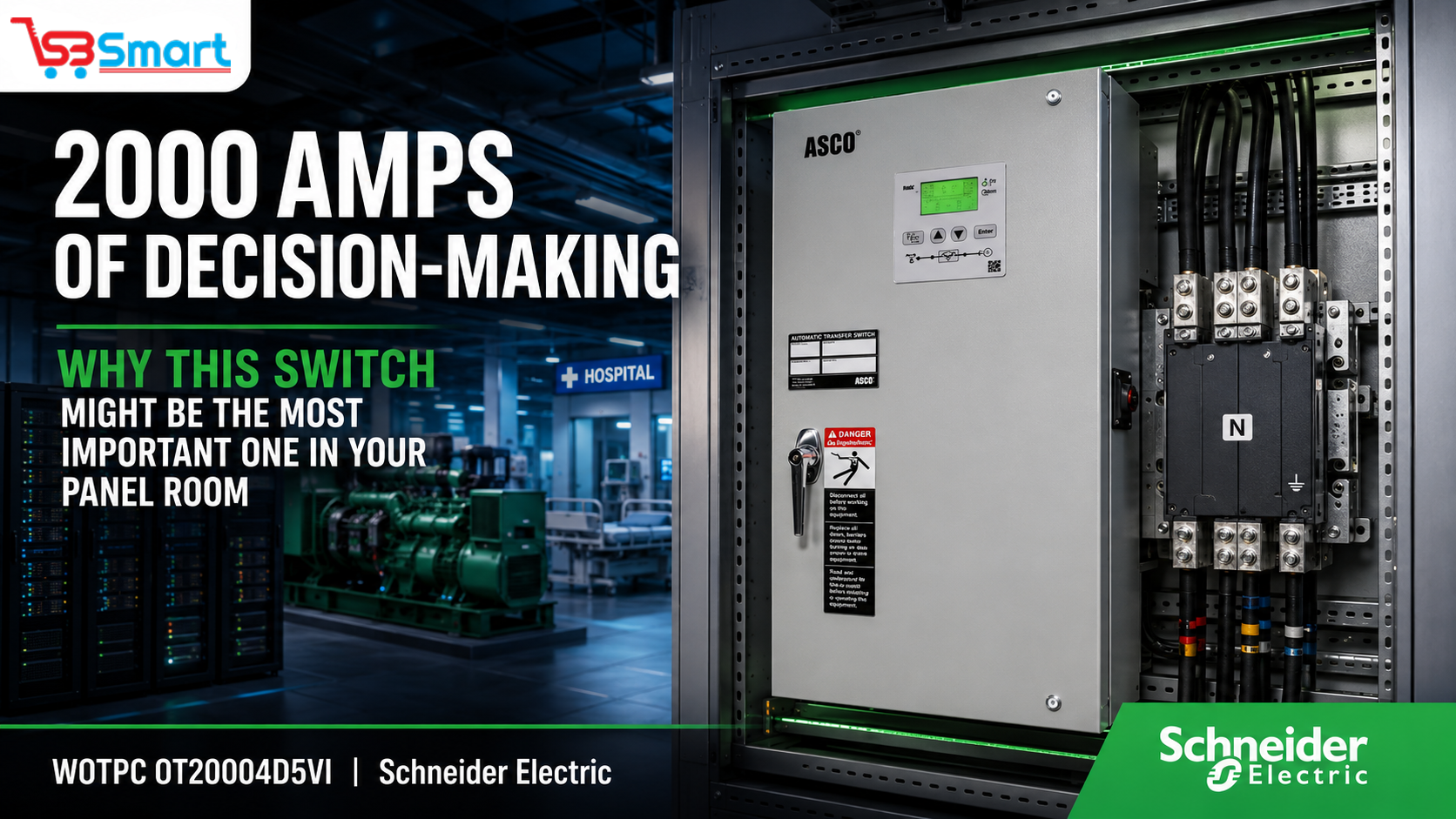
2000 Amps of Decision-Making: Why the WOTPC OT20004D5VI Might Be the Most Important Switch in Your Panel Room
Some electrical components get talked about constantly - VFDs, PLCs, soft starters. Then there is the automatic transfer switch, sitting quietly in a corner of the electrical room, rarely mentioned until the exact moment it is the only thing standing between a facility staying powered and a facility going dark. At a 2000A rating, the WOTPC OT20004D5VI is built for exactly that moment, at a scale most standard switches simply are not designed to handle.
If you are working on a project where the load is too large for a standard-duty ATS, this is worth understanding properly - what it actually does, why the 2000A/4-pole combination matters, and where it genuinely earns its place in a system.
What an Automatic Transfer Switch Is Actually Doing
At its core, an automatic transfer switch (ATS) sits between two power sources - typically mains supply and a standby generator - and decides, without human input, which one feeds the connected load at any given moment. The moment it senses mains power has failed or dropped outside acceptable limits, it initiates the generator start sequence and transfers the load once the backup source is stable, then switches back once mains power is confirmed restored. The WOTPC OT20004D5VI does exactly this, but built for a scale where the stakes and the current involved are considerably higher than a typical building backup application.
Breaking Down What OT20004D5VI Actually Means
2000A Rated Current - This is not a switch for a single floor or a small server room. A 2000A rating puts this firmly in heavy industrial or large commercial territory - think entire manufacturing plants, hospital campuses, large data centers, or commercial towers where the total connected load runs into serious numbers. Very few applications actually need this rating, which is exactly why getting it right matters so much when they do.
4-Pole (4P) Configuration - Switching all three phases plus the neutral together, rather than just the three phases. This becomes genuinely important whenever mains and generator supplies do not share a common earthing arrangement, which is common in real installations. Without full neutral switching, you risk circulating currents and neutral point instability that can quietly stress connected equipment over months of operation, long before anyone notices a problem. A 4-pole design removes that risk from the equation entirely.
Reference OT20004D5VI - This specific model reference identifies the exact current rating, pole configuration, and construction variant within the WOTPC range, which matters when it comes to sourcing the correct replacement part or matching accessories years down the line. At this scale, a slightly wrong reference number is not a minor mismatch - it can mean an entirely incompatible switch showing up on-site.
Why the Scale of This Switch Changes How You Think About It
A lot of what applies to a small building's 100A or 200A changeover switch simply does not scale linearly up to 2000A. At this current level, a few things become non-negotiable rather than optional.
Physical footprint and installation planning becomes a serious design consideration. A 2000A, 4-pole switch is a substantial piece of equipment, and panel builders need to plan enclosure size, busbar routing, and cable termination space around it from the very start of the design, not retrofit it in later.
Thermal management matters considerably more. At 2000A, even small inefficiencies in contact design or connection quality translate into real heat, which is why genuine, properly manufactured units matter far more here than they would on a smaller switch where the margin for error is naturally larger.
Switching speed and mechanism reliability carry more weight too, since a transfer failure at this scale does not affect one circuit - it affects an entire facility's worth of connected load simultaneously.
Where a 2000A ATS Like This Actually Gets Used
Large Manufacturing Plants - Where an unplanned power interruption does not just pause production, it can damage in-process material, trip entire process lines, and cost far more in restart time than the outage itself.
Hospital Campuses - Multi-building healthcare facilities where the combined critical load across ICUs, operation theatres, diagnostic equipment, and support systems genuinely reaches into this current range.
Large Data Centers - Facilities running enough server capacity that the total backup load requirement sits well above what standard-duty switches are built for.
Commercial Towers and Mixed-Use Developments - High-rise buildings with substantial connected load across HVAC, lifts, common area power, and tenant supply, where a single centralized ATS handles building-wide backup rather than multiple smaller units scattered across floors.
Heavy Industrial Facilities - Steel, cement, chemical, and process industries where continuous power is tied directly to product quality and equipment safety, not just convenience.
Points Worth Checking Before Finalizing This Switch for a Project
- Verify your generator or standby source is actually sized to carry the full connected load this switch is rated to handle - an oversized ATS paired with an undersized generator does not solve a capacity problem, it just relocates it.
- Confirm cable and busbar sizing at the panel design stage, since 2000A terminations require significantly more physical space and torque specification than standard-duty switches.
- Check whether your installation needs open or closed transition switching, and make sure the mechanism type matches your process requirements rather than assuming one size fits all.
- Plan for auxiliary contacts and remote monitoring integration early if this switch needs to report status back to a BMS or SCADA system, since retrofitting this after installation is considerably harder at this scale.
- Double-check the exact reference number against your project specification before ordering - at 2000A, sourcing the wrong variant is a costly mistake to discover on-site.
Sourcing a Genuine WOTPC OT20004D5VI
At a 2000A rating, this is not a component where cutting corners on sourcing makes sense. A failure here does not affect a single circuit - it can mean an entire facility losing power at precisely the moment backup was supposed to take over. That single fact changes the calculation entirely when it comes to choosing between a genuine unit and a cheaper, unverified alternative.
Current availability and full specifications for the WOTPC OT20004D5VI Automatic Transfer Switch are available at SB Smart. For projects involving a full backup power system design - generator sizing, switchgear, and transfer switches together - sharing your single line diagram or complete panel BOM is generally the fastest way to get accurate, coordinated pricing rather than sourcing each component separately.
The Bottom Line
Most people will walk past an automatic transfer switch a hundred times without giving it a second thought. But at a 2000A, 4-pole rating, the WOTPC OT20004D5VI is doing the kind of work that only becomes visible the one day it matters - the moment mains power fails at a facility large enough that the outcome depends entirely on whether this switch does its job correctly. For projects operating at this scale, that is not a detail worth leaving to chance.